Dramatis Personae

Dramatis Personae:

Keith, or Bear, a 61 year old male

Jody, or Beaver, a 57 year old crippled female

Bloodroot, or Goat, our 27 year old son

Bird, our collapsible manual wheelchair

Tinky-Winky, my walker

Sunday, January 15, 2017

Thursday, October 15, 2015 Holy Toledo!

Today we visit Toledo, Holy Toledo to be exact. Rolling over to Puerta de Atocha, we catch the 9:20 train out to Toledo. As cripples, we must always be one-half hour early for any ride. RENFE has a whole contingent of people delegated to loading disabled people onto their trains. (Disabled means those of us who can’t ascend the three steep steps from the platform to the train car level.)  The RENFE workers have cell phones and call ahead to your next destination. When you arrive, people at that station unload you, again via battery powered lifts (rampa).

Today, our tickets give us row six. RENFE uses their lift to load me on the train, Keith helps me walk halfway down the train car and Bloodroot makes my left leg move. I’m happy because we find and sit in the correct seats, unfortunately not a common occurrence for us.

In one half-hour, we travel forty-five miles south-west to arrive in Toledo, a walled medieval city built upon a hill. The train drops us off somewhat far from the old city ─unusual for Western Europe─in a beautiful Moorish-inspired train station situated in a plain below the towering Toledo.


We follow the crowd to the lovely accessible city bus, which kneels, not quite all the way, but low enough that the boys can bump Bird and me aboard. The delightfully strong bus motor drives us across the plain, over the Tagus River, through ancient gates up a frighteningly steep hill to the old center of the fortified city. The boys’ muscles rejoice in relaxing, at least for the moment, as the bus loudly powers a few tons of steel up a 30-degree incline. No pushing Bird and me to summit a big, daunting hill.

Exiting the bus at Plaza de Zocodover, Bloodroot and Keith take turns pushing me up and down the steep hills found in the city’s center. Our journey, a true workout, conquers elevations that vary considerably from one plaza to the next, or even one corner of a plaza to another. We traverse the peaks and troughs of an old and vertical development. Locals joke that all paths run uphill in Toledo. We believe ourselves saved from this cruel fate as Bloodroot has his iPhone with GPS, but au contraire! The iPhone issues bizarre directions leading us on a very convoluted, mountain-ascending trajectory through Toledo. IPhones ignore elevation, one of their many flaws designed to remind you of the danger of overreliance on a minute internet connection. We wander up and down and all over the place. Bear loves this. He enjoys the back streets and alleyways, dreaming of foraging in the old medieval city. His muscles don’t.


We first stop at the thousand-year-old mosque (Mezquita del Cristo de la Luz), partially converted into a church (the “Cristo de la Luz” part aka Christ of the Light), saving it from the medieval equivalent of the wrecking ball following the reconquista. Bloodroot kindly loans his mother his warm down jacket before crossing the street to tour the completely inaccessible building, where someone drew Jesus on the wall and stars on the ceiling. Bear and I happily bask in the warm sunshine, up on a hill, gazing at Toledo, enjoying the Moorish geometric designs on the outside of the building. Bloodroot decides, unexpectedly, NOT to buy anything at the conveniently located adjoining book shop, leaving us without a Toledo magnet or mug souvenir. He rejoins us.


After more convoluted trailblazing, we reach our second stop, the Cathedral. We drag Bear into the church as he kicks, screams, stomps and growls. He abhors all churches by this point in our progress through Spain, even this one, a very pretty gothic place replete with mudéjar (Moorish) architecture.


Despite Bear snarls and groans, we enjoy the tall stained glass windows with their pretty colors. We take a closer look at the various chapels, each dedicated to a particular saint. Mary is, of course, big. The Sacristy holds numerous religious paintings created by important artists (Goya, Velázquez, Titian, Rubens, Caravaggio). Having just visited the Prado, we breeze through. Spiritually sated, heaven bound, we find ourselves physically hungry.

Leaving the cathedral, we find a €13 fixed-price plate place called Coleccion Catedral. The boys bump Bird and me into the restaurant, climbing one step. Initially, we enjoy our plates of food. Slowly more patrons enter the restaurant. By the meal’s end, no one waits on us to bring us desert, tea, or the check. Via the servers’ incompetence, the restaurant wastes much of our limited time in Toledo, earning a C-.

Ah well, on to our third and final top, the Sephardic Museum, an ancient synagogue built, like many of the older buildings in Toledo, in an exotic pre-Christian architectural style. Moorish brickwork and tiles cover the walls and ceiling.  They dominate every space shining in bright blue, green, red and beige. Entering, I’m confined to one small space. The museum doesn’t really have much, most of the exhibits dull, the main draw being the astounding edifice itself. But finding this place has taken us a long way from the train station. The docent tries to explain the bus stop location, but ends up advising us to catch a cab back. Complying, we find a taxi and ride back down the hill to the RENFE station, ensuring we catch our train home.


Timely arriving at the Toledo train station, a RENFE woman hustles us on board, directing us to handicapped seating, for once. She continues to lecture us, telling us how to live our lives, I suppose. Cripples lack intelligence, requiring constant clueless advice from others. My limited Spanish precludes my understanding her. Bloodroot remarks, “She’s even more annoying if you know what she’s saying.”

One-half hour later, we arrive in Madrid. Leaving the Atocha station (at times our second home), Bloodroot expresses a desire to stop somewhere and have a hard cider. On the way home to our Lavapiés flat, we find a corner bar tapas place, called Santeria, selling the coveted hard cider.

Finding nice outdoor seating we sit down. Bear and I enjoy a glass of wine, while Bloodroot indulges in his hard cider. Suddenly a gentleman approaches us, interrupting our hard-earned reprieve. Instantly too close, invading our personal space, he begins to beg in Spanish. I look at him coolly, “No hablo español,” I respond. “That’s fine,” the beggar says, “I speak English. I’m down on my luck. Can you help me?” “No!” I respond calmly, “Please go away.” I say, according to my family gesticulating while I say it. “Boy, are you hard-core mom!” says Bloodroot in admiration. I feel I was unfailingly polite. After all, I said please. As the wheelchair-bound person, I no longer have any patience for people begging. I worry I’m becoming a Republican. All I think is, “You can walk, asshole. Go get a job for Christ’s sake.” The boys decide to direct all future vagrants to me. I fear I’ll be punched in the face for my attitude some day.


Bloodroot buys some hard cider in returnable bottles to take home. We depart. Reaching home, I snooze while the boys cook yet another delicious dinner. Indulging in their labor’s product, I realize, once again, how good I have it.

Sunday, January 1, 2017

Wednesday, October 14, 2015 Royal Palaces, History & Armor

Following a nice hearty breakfast, we again roll over the few blocks to museum-land. Yesterday, Bloodroot’s much disparaged iPhone led us up and down numerous steep hills on the way to the Prado. But by today, Bear has already memorized our location. Using his brain, he cleverly maps our path to the Royal Palace. He directs us around the hill instead of over it, a much easier walk and push. Bloodroot, the pusher extraordinaire, follows in Keith’s wake, mumbling gratitude. Bear’s brain-mapping faculty amazes me, as I never know my whereabouts. My directional abilities, never stellar to begin with, have completely disappeared since I no longer drive. My current general response “Wow! We’re here” tends to elicit scorn. (Or occasionally envy, as in, “Wow, we’re in Europe. How did that happen?” Just kidding. No one could forget the lovely, endless flight.)

Left to his own devices, Bear would only visit art museums: perhaps, at times, a logical choice. I, on the other hand, want to vary our events and tours, so today we visit the Royal Palace. In his bible, Rick Steves calls the edifice before us one of the three best palaces in Europe. (His opinion: 1) Versailles-Paris, 2) Schönbrunn[ -Vienna, 3) Palacio Real-Madrid.) I have toured the first two; I now plan to complete my experience.


Renovated by the Bourbon dynasty following the War of Spanish Succession, this palace resembles Versailles but lacks the history and intrigue of Louis XIV’s palace. No Hall of Mirrors.  Quick history moment: In 1700, the inbred, crippled Charles II (aka the Bewitched), the last Spanish Habsburg, died childless, willing his kingdom to the French Bourbon Philip, Duke of Anjou, Louis XIV’s grandson. The other European powers, appalled and duly terrified at the prospect of a French-Spanish union, began the War of Spanish Succession. Thirteen years later, the war ended in compromise. The Bourbon Duke of Anjou ascended the Spanish throne as Philip V but renounced any claim to the crown of France, for both himself and his successors.

Back to the palace. We approach the palace ticket desk. As a cripple, I enter gratis, a beneficence unknown in the States. First, the grand staircase greets us: imposing, perhaps more so as naturally we can’t climb it. We head instead for the ascensor.


Exiting the lift, we embark on the unidirectional tour through a narrow, industrially carpeted, roped-off section of each room. We don’t move fast enough, allowing large tour groups to rush around us and trap us in boring spaces. We meander through lots of big square rooms, none architecturally striking. We see Tiepolo’s moralizing frescos on various ceilings, but as usual, we need the more detailed explanations. We understand one where Aeneas, a Greek soldier, instructs the guards on proper behavior in the guard room. Acquiescing, we accept our rudimentary education and give up on enlightenment promised by 18th-century power philosophy disguised as moralizing lessons. Traveling onward, we enjoy the tapestries, designed by Raphael and woven in Belgium, and the Goya paintings. Some rooms have cool wallpaper; in others we find interesting furniture.


Our favorite room contains the royal collection of Stradivarius instruments: a cello, a violin-cello, and some violins. Previously, hearing these glorious instruments played required a personal invitation from the Queen Sofia. Bloodroot overhears a tour guide speaking in French. Through the tour guide (via Bloodroot’s translation), we learn that the performers now upload their gigs to YouTube so everyone can enjoy them.

Ok, I agree with boys. When we next visit Europe, we needn’t tour any more palaces. Keith will skip Schönbrunn should we ever visit  Vienna. (I found Schönbrunn  absolutely amazing but I was eighteen and obsessed with both Maria Teresa and the Austrian Habsburgs.) Bear growls that he wants to visit more palaces but tires of me dragging him into yet another fricking church.

But more importantly, am I outgrowing Rick Steves? We avoid his recommended hotels like the plague as they attract far too many Americans, people we can meet at home and needn’t travel to Europe to see. Some of the things Rick considers must-sees we could easily skip, like this palace.

Exiting, we find ourselves in a large square abutting the palace, La Plaza de la Armerίa. Bloodroot and I bask in the sun like lizards, while Bear, ever a bear, begins foraging. To the left of the palace, Bear discovers a museum full of armor, the Real Armerίa. Excitedly, he returns to the plaza to collect Bloodroot and me. We enter the museum, the royal armory, actually an oft-overlooked part of the Royal Palace. The boys love this place, having never seen so much armor. Will they begin dueling?


The museum includes the armor worn throughout the respective lifetimes of Carlos V, Felipe II, and Felipe III, much of it parade armor.  Royalty dressed their children in armor from the second they emerged from the cradle. The royalty wanted to prove they could produce living progeny, not an easy task given the infant mortality of the time and their extreme consanguinity. Viable offspring, aka living children (an heir and a spare), meant a stable succession, vitally important in these times. Otherwise, upon a royal’s death, the realm could descend into civil war, not healthy for anyone. As products of successful breeding, the children marched about, on display in parade armor showing off their individual royal elegance and bearing, reflecting their personal God-given divine mission to rule. Armor, never cheap, affirmed the king’s wealth, especially as he could afford armor to strut about in, not needed for the dirty work of fighting. As the court moved through the country on a royal progress, in every town, royalty had the opportunity to showcase their children swaggering about in armor. Owing to the era’s primitive sanitation, the court moved often, allowing servants to clean up the mess left behind.

We leave the royal palace and find a place to have lunch with €10 fixed-price plates. Wow! A good deal and good food! Unfortunately, we find this a rarity in Madrid. We enjoy a slow, leisurely lunch of delicious food and wine.


Sated and emboldened by our late lunch, we consider ourselves ready to visit another museum. “No more churches or palaces!” growls the Bear. 

Heading out for the next museum, Bear stops in a sweets store and buys a dark chocolate bar with hazelnut bark. Now happy compadres, we approach the Thyssen-Bornemisza Art Museum located next to the Prado (known locally as the Thyssen), an acceptable animal selection. Entering and purchasing tickets, we face a dilemma. It’s 4PM and the museum closes at 7PM. Shall we see the Munch exhibit with many paintings borrowed from the Munch Museum in Oslo or tour the museum’s regular collection? (Somehow I’ve been to Oslo twice, but never toured the Munch museum. All people of Norwegian descent must visit Norway repeatedly, God said!) We choose Munch.

The guest exhibit of Edvard Munch, an artist unknown to me outside of his Scream painting, occupies an entire wing here. We go from room to room as Munch’s words explain the surrealistic ideas behind his paintings. With Munch’s art we explore archetypes of love, desire, jealousy, fear and death.

I have always believed that surrealism arose as a response a World War I, the war that did not end all wars, but simply set the stage for World War II. Responding to the futile, endless, ludicrous slaughter of WWI, artists began to look within. Yet the surrealistic Munch painted the feelings flowing from within his soul in the 1890s. Another of my cherished beliefs falls, victim to reality presented in European art museums.

Munch dwells on the changing roles and lives of women during his lifetime. He believed that the world changed irrevocably when women escaped the corset. As freed beings, women gained the upper hand, holding all the power men had always lacked. Munch once drew woman as the femme fragile, depicted in profile standing off to the side of a painting. Later his women boldly stare out at you, front and center on the canvas proudly embracing their seductive power as femmes fatales. They move from playing a supporting role to ruling all that they see. In other works we find women’s lives, graced at long last by self-actualization, still remain haunted by the all too human frailties of sorrow and death.

Munch explores his feelings on love. He embraces the scary free woman full of both Eros and Amor, painting glorious kisses, but also depicts her as a vampire.

Leaving Munch behind, we think about spending the next hour with the regular collection because the ticket vendor told us our tickets permitted multiple entry through the remainder of October. We approach the lifts accessing the permanent collection. “Au contraire!” says the fairly unpleasant ticket collector stationed at the entrance. She stamps our tickets, telling us we have an hour. We complain loudly and bitterly, our animal vocalizations upsetting the other museum patrons. “OK, OK already,” she concedes, un-stamping our tickets. Now thoroughly annoyed, she actually gets up off of her chair to shoo us away. “Come back another day!” she huffs.

Leaving the museum before being escorted out, we roll around the hill toward home. Back in the ‘hood we shop for dinner, again buying food to prepare, accompanied by some bread and wine. Arriving home, Bloodroot runs up the four flights of stairs, gathers Tinky and sends him down the elevator. I transfer from Bird to Tinky and ride the lift upstairs. Exiting, I send the ascensor back down. Keith folds Bird, loads her into the elevator, sending her also up four floors. He walks upstairs too. Animals and mobility devices reunited, we enter our flat and begin cooking.

The boys create a nice dinner of chicken and broccoli. We enjoy our wine and turn in for the night.

Saturday, December 10, 2016

Tuesday, October 13, 2015 Center of the Art Universe, the Prado

Good morning, world! We are safe and sound and snug in our new Airbnb palace in Madrid. What a difference a good night’s sleep can make! During the night, I realize that the bed sits delightfully low to the ground.  By myself, using Tinky, I can walk over to the bathroom. Parking Tinky at the miniscule bathroom door and holding the walls, I can back up to the toilet. Excepting the elevator, I feel that this place was designed for me!

Our Airbnb flat is in Lavapiés, the Jewish neighborhood before the 1492 expulsion. Wikipedia posits that the name Lavapiés, or wash the feet, comes from washing your feet in a fountain before entering the temple. Naturally, following the reconquista, a cathedral replaced the synagogue. All history aside, our flat sits smack dab in the center of museum-land and quite close to the all-important train station, Puerta de Atocha. We can easily walk to most sites and needn’t use the Metro. Rick Steves calls this neighborhood “edgy”. Greatly appreciating the absence of other tourists, we see no problems whatsoever. I rate a neighborhood by whether or not older women venture out and walk about by themselves in the evening. Lavapiés passes; no one harasses anyone.

Now I have only to convince the boys that the glory of our central location surpasses the hassle of the elevator. “We won’t even need the Metro,” I proclaim. They require little convincing. Putting their shaggy animal heads together, they devise a scheme whereby they set me on Tinky the walker, push the walker into the teensy-weensy lift and send me up or downstairs. The boys arrive shortly thereafter, pull Tinky and me out of the ascensor. I wait as they fold up Bird and send her along in a separate trip. Once Bird and I reunite, the boys reassemble Bird, set me on her and then send Tinky back. Thus, every elevator ride requires three trips, but does bring us success. 

But not so fast or perhaps too fast! The floor of the foyer slopes toward the street. I learn to always set my brakes lest I, in whatever wheeled contrivance I sit, begin to drift toward the outer doors, accelerating as I go.

Today we visit the Prado, the last major European museum remaining on my bucket list. Following the Prado , I will have visited all locations/museums listed in Rick Steves’ Mona Winks, a major lifetime accomplishment. (I have since added the Hermitage to the bucket list.)

Bloodroot targets the Prado via GPS.  Following his iPhone directions, we walk up and down hills near the flat. Bloodroot pushes me with the exuberance of youth, while locals roll their eyes, laughing at our difficult, hilly path.

Reaching the museum, we roll up to the ticket counter. The clerk insists that I prove I’m disabled. I brandish my Social Security disability award letter. Thus far in our adventure, no one in authority has requested proof of incapacity, allowing Bird’s mute presence to speak for us. Bird’s shyness countenances verbalization only with the family. The clerk then demands my passport as after all I may be faking that I’m crippled in order to save €5. Think about it! The museum must defend itself against hordes of Norteamericano tourists rushing in, renting wheelchairs to fake cripdom, all in order to save €5. That the wheelchair rental would cost €20 is completely irrelevant. Perhaps the Prado has a motto: No one gets a reduced rate! They’re all fakers! In Denver, I purchased two museum tickets online but forgot about Bloodroot. We buy his ticket and also a €6 Prado Guidebook.

Bloodroot wants to see every single thing in the Prado. He even moves more slowly than we do, a feat I previously considered impossible. Is God laughing when your children grow up to be more you than you? I hope that someone finds amusement in our predicament. The Prado, a humongous, intimidating museum, has two floors. Sighing, we begin with the lower level.

The first room contains a wonderful self-portrait of Dürer as a young man, the German boy dressing like an Italian princeling. Spanish gentry bought the painting from England’s Charles I’s estate. Nearby, we find Durer’s depiction of Eve and Adam with very pretty, happy bodies, oblivious to or despite their impending fate. Make hay while the sun shines, eh?

The Prado Guidebook turns out to be a fantastic investment, incredibly useful as we traverse the museum. Reading the book later at home makes me chuckle. The authors are incredibly stuck on themselves and their museum, but it is the Prado, after all. They constantly compare themselves to the Louvre, considering themselves far superior to the Louvre as the Prado’s collections originated as gifts from the Spanish royal family whereas the Louvre began when patriots expropriated art during the Revolution.

On the Prado’s first floor, we wander, enthralled, through the most amazing display of Renaissance paintings known. We enter a room bedecked with all sorts of Bosches and Bruegels. Once inside, we join the line and see Bosch’s tryptic Garden of Earthly Delights. The painting begins on the left side with the Garden of Eden then progresses through many earthly sins that look like a lot of fun, before people’s eventual fates in heaven or hell─mostly hell. Intended as a lesson on the consequences of ignoring Church dogma, the painting’s message is lost on us as we can’t decipher the sermonizing (which we’d probably reject anyway.)  We gawk at the eroticism of both the sins and their punishments, trying to untangle the progression from one to the other.

A few feet away, we find a really cool table showing the seven deadly sins, also by Bosch. As heathens, we can’t decipher which sin is which. Fortunately we have the Prado Guidebook which explains the allegory behind each sin.

Keith, a big Bruegel fan, pays homage to Pieter Bruegel the Elder’s The Triumph of Death, where ─ much the same as Bosch ─ myriad people run about on a very busy canvas, dying in various gross ways. An army of skeletons approaches from the canvas’ east. Bruegel’s next work, The Wine of St. Martin’s Day, also has lots of people running amuck, but this time drunk and happy. All of these works provide us with a glimpse into the very strange world of the 1500s.

Bloodroot and I believe we find the painting gracing the cover of Steven Pinker’s The Better Angels of Our Nature. With further research, we learn that Pinker used the Rembrandt painting called The Sacrifice of Isaac for his cover art. The Hermitage in St. Petersburg owns this painting. Whoops!

Bloodroot’s favorite, Fra Angelico, has one large painting in the Prado, portraying the life of the Virgin Mary. I wonder: What is her last name? Did she keep her real name? What is Jesus’ last name? Enough woolgathering!

Bloodroot enjoys the medieval religious art that I find odd. He likes the way people took gold, the most precious thing known, and plastered it all over the paintings. I see so much gold that I believe artists cut photos of people out of magazines and pasted them atop gold backgrounds. Bloodroot also gazes lovingly on some frescoes from around the year 1000 that the Prado preserved by pulling them out of some old church facing vandalism. The frescos feature very white people with big eyes, recognizably like us, Europeans.

Unfortunately Renaissance art involves a lot of Jesus art. We see numerous Marys and Jesuses, all created by very prominent Renaissance artists, but you can only see so many Jesuses without screaming, leading to your being forcibly medicated and sedated. We also see lots of pagan mythological allegories. I have always liked these due to the absence of Jesus. Bloodroot abhors them, finding them worse than the Christian art.

Keith and Bloodroot both love the Goya paintings. We begin with Goya’s self-portrait showing a brooding, intense, thoughtful man, hungry for life. We quickly scan his royal portraits and religious paintings. We slow down, enjoying his numerous depictions of everyday life around 1800. In the 1820s, Goya, old and going deaf from syphilis, descended into his dark period, using fewer and fewer colors, painting witches, duels, Saturn devouring his young and other dark subjects. Old, sick, and facing mortality, anguish rolls off of him in a surrealistic orgy onto the canvas. Could Goya simply have been ill with neurosyphilis, the fate of so many before antibiotics brought effective treatment of this incredibly common disease? Of course! Whatever the impetus, Goya painted his nightmares and feelings, foreshadowing the Surrealism movement by a century, perhaps inventing it. The Prado has over 150 Goya paintings.

Next, we find a room with an Alanso Cano painting of Mary projectile-lactating into St. Bernard’s mouth. Bernard, thoroughly obsessed with the Queen of Heaven, reforms the Cistercian order. Mary’s milk appears often throughout the museum, presented as a panacea for humanity’s sufferings. I’m surprised that the Holy Virgin lactated. No formula in the Roman Empire, eh? In another canvas, Jesus squirts Mary’s milk onto sinners in purgatory to soothe them in their time of need. Her milk cools the flames tormenting them. Jesus has a mischievous grin on his face as he delights in playing with his mom’s boobs, squirting her milk here and there. I am not making this up.


We discover another canvas showing Cleopatra with the asp about to bite her boob. Some artists picture their invented history in the most prurient terms possible.


The Prado prides itself on its extensive Spanish collection. Keith agrees, enjoying the Spanish stuff on the bottom floor, including portraits, landscapes and Goya.

But I am damning the place with faint praise. This may be the finest art museum we’ve seen. Keith just made a choking noise so perhaps he disagrees. He still calls the museum the Prada, no matter how many times I mention that Prada is an expensive shoe store and Prado a painting museum in Madrid.

Over the course of four or five hours, we work very, very hard and see the entire bottom floor. Pretty spaced by now, we think about going outside to buy something for lunch but realize we won’t be allowed back in. Herded down to the museum cafeteria, we find a place fairly reminiscent of Bosch’s depictions of hell. Many museums now pride themselves on their in-house restaurants. The Catalan Art Museum comes to mind, where we enjoyed our finest meal in Barcelona.  I’m sorry to report that the Prado bucks this trend.

In the greasy cafeteria, we buy some amazingly overpriced quasi-food ─ a bit of obscenely salty chicken, a beet salad, and what might at one time have been vegetables. €28 for the worst food we’ve had on the entire trip! Rick Steves describes the cafeteria food as adequate. Bah! Perhaps we have outgrown him.  

No longer starving, we leave a good bit of the food on the trays, running off to tackle the top floor the museum.

We find the ascensor which Keith logically calls the ascender, and rise to the second floor somewhat like Mary being sucked into heaven. The second floor features Velasquez’ Las Meninas, a truly amazing work. You peek inside Philip IV’s family, watching the Princess Marguerite surrounded by her maids, dwarves and tutors. Her parents, reflected in the mirror nearby, evince pardonable pride in their pretty little girl. (Consider the endless inbreeding making it amazing they produced any living progeny.) I sigh, thinking of her brief and tragic life. Imagine yourself engaged while still in your cradle, a marriage pawn, the fate of an infanta. I find myself unduly attracted to her, wanting to defend and protect her because she so resembles me as a child, towheaded with piercing brown eyes. But does the portrait lie? Velasquez worked for Philip IV, painting pretty marriage portraits to send to Marguerite’s future husband in Austria. Did she have the Habsburg genetic underbite? Not in this portrait. In real life, she wed her uncle, twelve years her senior, endured six pregnancies from the age of 15 to 21 and then died.

I like Velasquez’ paintings of historical personages (primarily royalty) but then I love history. The boys, lacking my enchantment, pick up the pace. Forever trapped in Bird, I meekly go where they take me. (They disagree, insisting that I never have been or will be meek, or a member of the Communist Party.)

The rest of the second floor obsesses on masters painting nearly identical portraits of long-dead, unknown Spaniards.  Created in the 1500s and 1600s, cloaked head to foot in black with a white Elizabethan starched ruffle collar, I wonder how these people even sat. Did they remove their collars to move? I try to picture them dancing or fencing or doing anything other than standing there staring at me. Although well done, we find the portraits exceedingly boring as we don’t know anything about any of these people. The paintings also go on forever.

Having seen all the art we can take for one day, we make to leave, naturally first seeking the gift shop. Keith wants to shop in a Prada at the Prado. He would ignore the shoes, concerned that any high heels would harm his big bear claws, hampering skiing.  He wants a Prada purse. He would carry a book in his purse, which he could pull out and read anywhere, just like his son. Gauntlet thrown, the boys begin a manliness competition. I enter the fray, suggesting dinner. My fellow animals accept the food proposal with alacrity.

We think about going to Charles III’s botanical garden neighboring the Prado but find it closed. And we’re hungry. We head for home and begin gathering food for dinner. Since unlike a swanky hotel/resort part of town, people actually live in Lavapiés, we find numerous meat purveyors, fruit and vegetable stands, wine shops, beer stores and ─ for things that fall into none of the above ─ a Carrefour. (I consider Carrefour the Walmart of Europe; Bear says no, the Safeway.) After procuring some chicken and vegetables we roll home. The boys create a delicious meal. This Airbnb has a dishwasher, delighting the boys, although they never use it. They just like to watch.

Thursday, November 24, 2016

Monday, October 12, 2015-Down to Madrid on Spain's National Holiday

Obeying Patricia, our San Sebastián Airbnb concierge, we stocked up on food Saturday as she insisted that nothing would be open today (Monday). Today reveals her claims to be completely specious. The fair continues. Perhaps Patricia believes that patriotism reigns supreme, but it doesn’t. For good or ill, money to be made harvesting the tourist trade overrules the symbolism of Spain’s National Holiday.

We gleefully note that many holiday visitors have already left Sunday to return to work tomorrow (Tuesday). “Yeah,” we think, “fewer people on the trains.”

After packing our remaining still-wet clothing (mostly jeans), we embark upon a two-hour whirlwind tour of the city.


We begin with the fair, enjoying the multi-hued booths open for business. Bear pushes Bird and me through the quiet streets before anyone else arrives. I see nothing I wish to purchase but enjoy looking. (Window licking, the French call it, but we have no windows. Don’t go there!) But if this really were the Middle Ages and I had one chance to shop all year, my attitude would alter and the merchandise would become much more appealing. I might be forced to buy one of everything! Oh no, no credit cards, cancel that fantasy.

Keith buys some doughnuts, freshly made. One bite of the anise flavored cake donut entrances him, my happy Bear. Delirious, he propels me down the streets out to the waterfront to look at the ocean. We see people attempting to sunbathe on the beach despite the cool weather. We find the aquarium, also not closed. We wander back in front of our house and get some coffee, tea and bad tapas at an open restaurant.

Back upstairs, Bear calls me to our balconies repeatedly to watch the fair unfold right below our flat. I catch sight of the medieval costumed people sauntering down the street playing antique instruments. I miss the more exciting acrobats, including the woman walking on a ball while jumping rope, preceded by a juggler, and followed by a man pulling a cart collecting donations.


I anxiously await a text from Bloodroot. As a mother, I find it impossible not to worry as my one and only massively beloved son flies in to Madrid from South America (Santiago, Chile). Seeking contact, I open my phone over and over again. I try to be discreet and unobtrusive as Bear will laugh at my worry. I fail; Bear teases me mercilessly.

Shortly thereafter, the landlady from our Madrid Airbnb calls asking for Bloodroot. Since Bloodroot will buy a phone when he lands, he currently has no phone number, and I can’t help her. She will look at his flight to see if it’s delayed and wait a while longer.

Meanwhile our taxi arrives to take us and all of our junk 500 meters to the train station. We engage in a hilarious quasi-discussion as my elementary Spanish deserts me and he “no habla ingles”.

At the station, we encounter our first (and fortunately only) amazingly nasty RENFE employee. The laziness of this woman defies imagination. All we need the bitch to do is walk ten meters and activate the battery operated ramp lifting me onto the train. She acts like I’m pulling out her eye teeth. We’re amazed as we’ve found the RENFE people bored and incredibly helpful as we give them something to do to relieve the monotony of clock watching. Not this puta. She first informs me, as I sit in Bird, that I can certainly ascend the three steps onto the train. We vehemently disagree, saying “Rampa, rampa” repeatedly. In her next attempt to avoid work, she badgers an English speaker into telling us that we needed to reserve the disability service 24 hours in advance and perhaps only through her goodwill she might condescend to help us. We begin to shout, “We were here Saturday and told to return 20 minutes early! What is the problem?” The English speaker rolls her eyes and tells her miserable co-worker to do her job. Señora Unpleasantness takes my name, ostensibly to call ahead, and with great reluctance loads me and Bird on the train. She refuses to assist with luggage, leaving Keith to trail behind us heavily burdened. Every other RENFE person has taken at least one suitcase in their free hand.


Unfortunately, today we have to manage two trains, the only thing I could find online (back in Denver) from San Sebastián to Madrid. After listening to Patricia, I was concerned that even RENFE would close today. This morning, RENFE’s website listed eight trains to Madrid today, all sold out. More unnecessary worry.

I don’t have too much trouble getting into my seat. The conductor stops by, insisting that we move Bird two train cars away and fold her up. Complying, Keith discovers the unoccupied handicap accessible spot where he feels we should be sitting in the first place. But RENFE will only let you sit in the seat you purchased. At times they can be kind and move us, but not today, as the holiday has left them screaming busy. I have a lot to learn before I book train tickets again.

Three hours later, a ramp meets us as we exit the train at Zaragoza, halfway back to Barcelona Sants. Gracious people move me and our stuff up one platform, through the ascensores, and down to another platform. We await the fast train to Madrid coming out of Barcelona. Sometimes I feel as though every train we take wants to send us back to Barcelona, specifically Barcelona Sants train station.

Personnel hustle us onto this train and abandon us with a chorus of “Baila, baila” (dance, dance). Actually, they say “Vale, vale” (OK? OK?). The fast trains have a very tight schedule, never stopping anywhere for long. We notice our seat numbers are 7A & B, halfway down the train. It’s 8:40 PM; I’m completely exhausted, but I begin to walk down the aisle as Keith holds my arms, keeping me upright. But my left leg will not move forward at all. This causes massive consternation among the other passengers. An incredibly kind woman and her daughter sitting in the last seat by the train car door jump up and trade seats with us. In our travels, we experience many random acts of kindness that earn our eternal gratitude.

Our first train took three hours to get to Zaragoza. This train, a high speed AVE (bird) train, flies along the tracks a longer distance to Madrid in an hour and 20 minutes. At Zaragoza, they’re so busy shoving us on to this train that they don’t really care where we put Bird, so we put her by the door. She’s happy to be near us, often frightened when she feels abandoned, folded up several cars away.

Every long train ride comes with a movie both dubbed and subtitled in Spanish. The conductors hand out ear buds that we never understand. But most people seem to find the buds easy to use. Viewing this film for the third time, we wonder how often RENFE changes films. RENFE began running the film before we boarded, so we only see the last part. The movie, called St. Vincent, stars Bill Murray. I note that Murray looks a good bit worse for wear. Keith says that Murray always looked scruffy.

At long last, Bloodroot calls, telling me that his plane crashed, stranding him in the Azores. Panicked, I momentarily believe him. Where did he learn to be such an inveterate smart-ass? Could this be his upbringing? Naturally, despite my motherly paranoia, his plane landed on time at Barajas, Madrid’s airport. He took a while getting across town in a new city but eventually found our new landlord. After receiving the keys, he settled in for a nice, long nap in our new Airbnb. We arrange to meet at Customer Service for handicapped folks in the Puerta de Atocha train station when our train arrives at 10PM.

When we pull into the train station alas, alack, no ramp greets us. Someone has dropped the ball! I suspect, perhaps unfairly, the nasty creature in San Sebastián.

This is how today begins to feel to us.


We watch in horror as everyone pours off of the train. No ramp arrives. I am stranded, three steps above the platform. In terror, I fear the train will just drive off with me on it. After what seems an eternity, Keith flags down three train conductors who stop and consider my predicament. They chatter in Spanish, reaching some agreement amongst themselves.

The three strong men approach my train car, hoist Bird and me, shouting uno, dos, tres and set me on the platform. The gentleman with the best English begins to push me while dragging one of our suitcases. Keith trails behind with the remaining baggage as we roll up to Customer Service. I learn the high-speed train is actually a German train, very long and strong. The conductor expresses great pride in the train. “It goes 300 kilometers per hour!” He continues in a different vein, “Madrid feels like and is a real city, unlike Barcelona, which is basically a tourist mecca.” He updates me on all the cool things to see in Madrid. I relate our planned Madrid itinerary and he approves.

He has visited the States seeing San Francisco, Las Vegas, and the Grand Canyon. What would those three places teach you of America? San Francisco, expensive yuppies; Las Vegas, addiction and tastelessness; Grand Canyon, beauty. So we’re a beautiful, expensive, addiction-prone people lacking taste. Perhaps correct, no?

The conductor delivers us to Customer Service, still open. In halting Spanish, I explain that we plan to meet our son here. No Bloodroot. The clock passes 10 PM, 10:15, 10:30. We call his phone as he calls us, but Vodafone does not consider our calls important and constantly drops them. We can’t get through. Finally our phone rings. Rejoicing, we hear Bloodroot’s voice. He’s been waiting by the Information desk where all the normal passengers file out as they exit trains. The boy never has listened. Handicapped people roll through secret ascensores to Customer Service. Drama resolved, Bloodroot greets us a few minutes later.

Bloodroot insists we need no taxi. He grabs some luggage and leads us to our little apartment, easily within walking distance.

But the drama of this day never ceases! The apartment elevator, probably once a broom closet, in no way accommodates Bird, though she considers herself a petite wheelchair. Indeed she meets all size requirements in the States where everything is huge. Here, she greatly exceeds elevator width. Bloodroot runs upstairs. Assisted by a nice neighbor, Miguel, he gathers a kitchen chair for my seat that does fit in the elevator. They send the elevator and chair down. The boys sit me in the chair. The elevator lifts us four floors. Success!

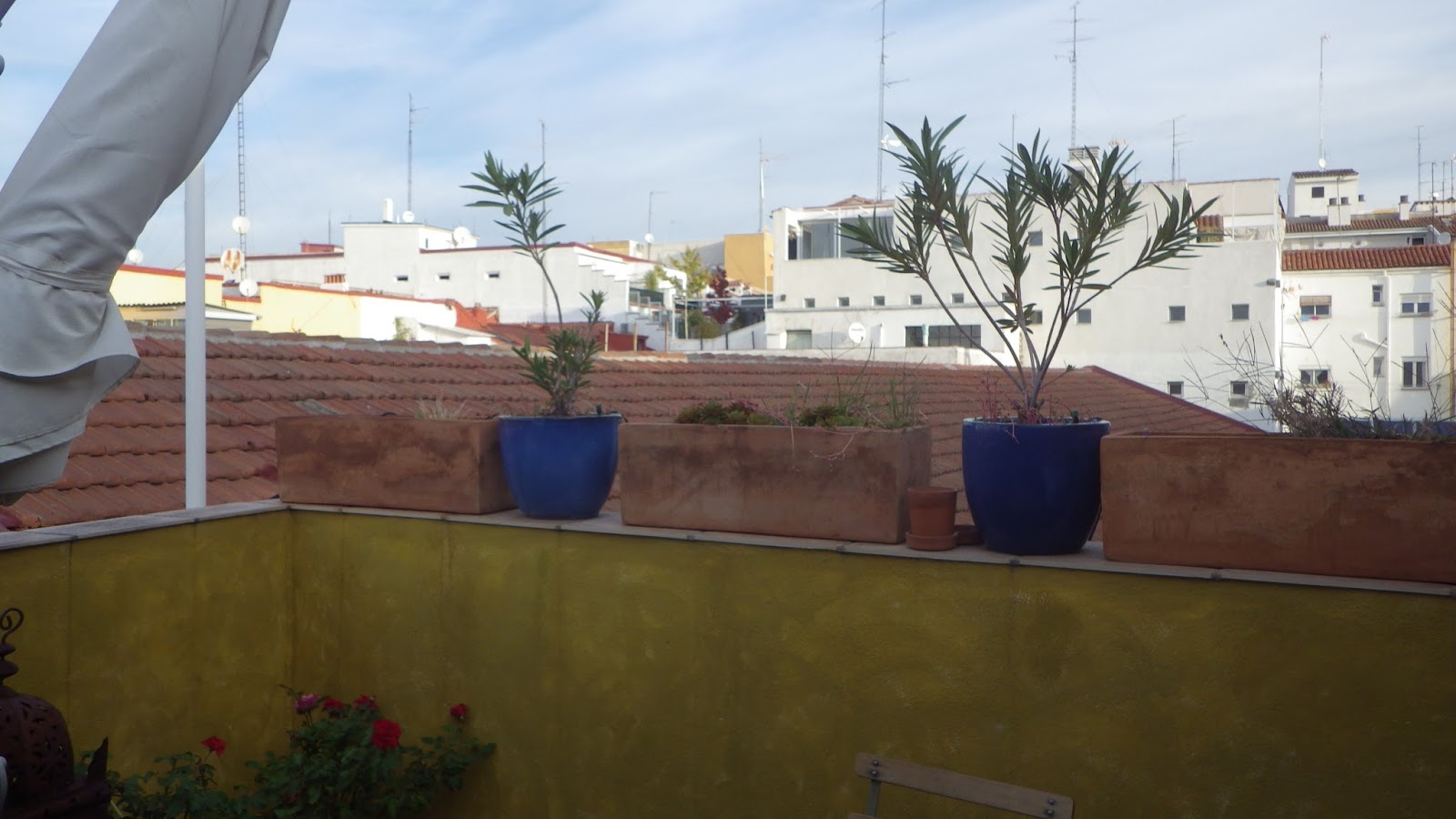
We enter our new flat. This flat has a full kitchen, including a dishwasher. We have a double bed on the floor, a kitchen table and a very, very tiny bathroom. I fear I will not be able to access the bathroom by myself. We also have a terrace upstairs, where Bloodroot sleeps. (Photo from a later day.)


Following a vocal animal greeting, Bloodroot tries to tickle Keith but to no avail. Keith squirms, but never giggles. He renames Bloodroot “Ticklehoof” the dancing goat.

We dine on the food we had prepared for the train. Concerned about both the elevator and the bathroom, we give Bloodroot the task of finding somewhere else to stay. He utilizes his computer skills, but fails to discover anything costing less than €250 a night. He finds nothing centrally located. Very late, 1 AM, we turn in for the night.


Sunday, November 13, 2016

Sunday, October 11, 2015 - Bilbao

Good morning, world! This morning, lacking yesterday’s hunger and crowds, San Sebastián already looks better. We begin today’s massive adventure by walking down to the Termibus station to catch the PESA bus to Bilbao. Contrary to everything on the PESA’s website, we don’t really need a reservation for the wheelchair. Spain long ago joined the European Union, so unlike the United States, all public transportation must be handicap accessible.

The bus, a touring ark, has a ramp in back that lifts me and Bird up to bus seat level. A secret door opens and in I roll. Only one fly in the ointment: the bus driver finds the ramp’s operation incredibly confusing. Were this accommodation not so vital to our trip, the situation would be hilarious. I don’t think that the bus operators encounter many cripples in wheelchairs. Eventually, with the assistance of other PESA workers, the driver lifts me on the ramp into the back of the bus. The scary ramp pops me into the air, a few meters off the ground. I pray that Bird’s brakes hold. Now I’m up with all the other tourists and I didn’t even have to walk up any stairs. The employees strap Bird’s wheels onto the bus floor. Lacking the common sense God gave a rooster, I don’t fasten my seatbelt.

Our bus charges out of the station like a freed stallion, off to Bilbao, an hour’s journey. I would call this another physical therapy hour as the bus careens rapidly down hills and mountains, eternally flying downhill, turning right then left following the curves of the road, amidst intermittent hard braking. I do my best to remain seated. We fly past the countryside, where heavy industry sustained Franco for so long. Strikingly beautiful vistas form Spain’s Rust Belt, just like the Midwestern US where both Bear and I hail from.


After a very scary hour, entirely my own fault, we arrive in Bilbao. Having left the Rick Steves bible at home and thus lacking easy directions to the Bilbao tram, we wander around a bit, in and out of a RENFE station, taking one ascensor down and another up. (We took the bus because Bilbao lies an hour away from San Sebastián by bus but two-and-one-half hours by train.)

We eventually find the tram, which, as advertised, cruises along at ground level, completely accessible. We ride the tram up to the Guggenheim, today’s destination ─ in truth, the entire reason for the side excursion to San Sebastián. Again, lacking our bible, we don’t cancel our tram tickets before we board but fortunately no one arrests us for our faux pas. Assuaging our guilt, we cancel the tickets as we exit the tram.

Despite my usual obsessiveness, I didn’t buy advance museum tickets in Denver. But we get a bye with the wheelchair. The staff wheels us to the front of the line and I purchase tickets at only six euros for Keith, free for me (€13 each regular price). Go figure.

The outside of the Guggenheim amazes us. The building itself, designed by Frank Gehry, lies beside the Nervión River.


We enjoy the larger-than-life outdoor sculptures. A pond next to the building contains a fog sculpture and a fire fountain. As could be expected, fog rises from the fog sculpture, producing a ghostly presence far cooler than it sounds.


We see a huge Jeff Koons sculpture of brightly colored tulips.

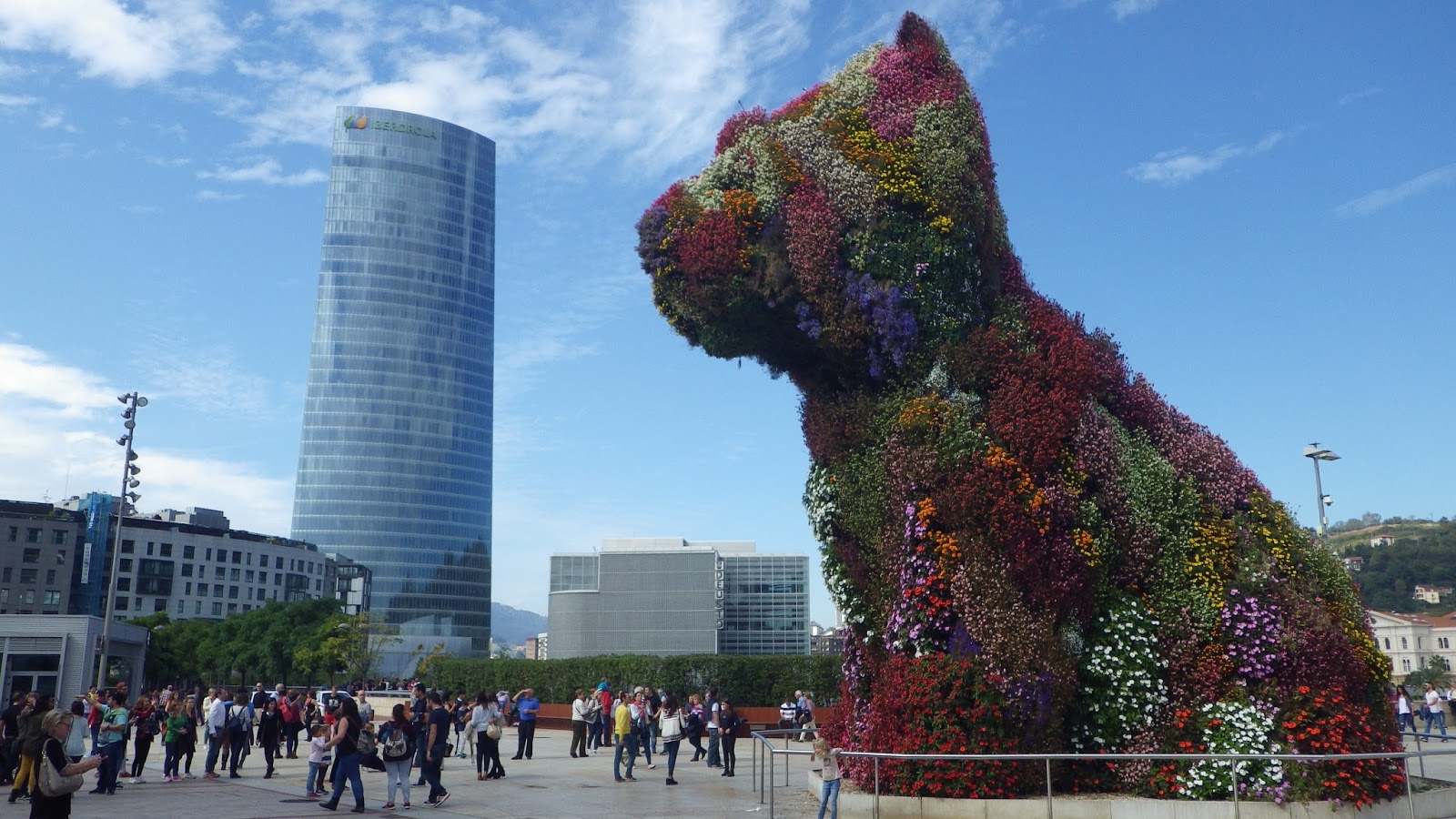
Bear spots a large topiary bear, also by Koons. We read the placard next to the bear and discover that it’s really a puppy dog. “You know you can be just too damn educated,” growls the Bear. I agree, I would prefer to have believed it was a bear made in honor of my bear.

We see a big spider and a tree made out of ball bearings. “Silver balls,” says the Bear.

But the inside of the Guggenheim severely disappoints. The three story museum dedicates the entire top floor to huge exhibit of Jean-Michel Basquiat’s work. Long ago, back in the States, Bear and I had watched a movie about Basquiat, so we look forward to seeing his art. Basquiat began as a graffiti artist, befriended and collaborated with Andy Warhol, rose rapidly in the New York art scene, and died at 27 from a heroin overdose. But looking at his work, I note no talent whatsoever. One of Basquiat’s often repeated quotes is “Believe it or not, I really can draw.” The exhibit provides no evidence of this purported talent. Bear grumbles, “I don’t like art that people have to explain to me.” I couldn’t agree more. Nothing moves me; nothing touches me. We exit stage right to the ascensores.

We attempt to descend to the second floor but find it closed, the elevator refusing to stop there. We learn that the second floor had previously been dedicated to a Jeff Koons exhibit that just ended. Bear feels I would’ve liked that. Lots of colors.

So down we go to the first floor. This floor holds a huge room full of humongous steel mazes. I enjoy hearing the kids squeal as they walk through the exhibit, their cries of joy bouncing off of the walls. Bird easily negotiates the enormous artwork.

Walking over to a darkened room, we find nine blue LEDs stretching from the ceiling to the floor. At first I am drawn to this art because, after all, it has color; it’s blue. Approaching the installation, the tickertape-like LEDs actually dissolve into words. Naturally I have to try to read them, which gives me a headache and makes me feel a wee bit nauseous. At this point, we escape the Guggenheim.

We walk along a grassy knoll following the tram tracks back to the bus station, a nice, peaceful and beautiful journey. Fortunately I have the Bear, because I would probably go the wrong way on the tracks, wandering witless like an ant without a scent-trail, and die. This digression ignores the problem that I am not ambulatory.

As we stroll along, we search for somewhere to eat lunch. We settle on a restaurant, Taquillas Guggenheim. We eat some mediocre tapas or pintxos and, far more importantly, partake of some wine and Advil.

After the wine, we think about having sex on the street. We find Bilbao so quiet that the imp of perversity encourages us to stir the place up. Can you imagine, a cripple arrested for fornicating in public? Bear feels he needs time and more wine to devise some sort of contraption with levers and pulleys. “I think it would be more like block and tackle,” he says, “especially if you’re on top.” Eschewing the fantasy, we leave the restaurant and continue our walk to the bus station to await our return bus. I booked a fairly early bus back, 16:00.

This time we board a brand-new bus. This driver understands his lift and loads Bird and me without any difficulty. Unwilling to disturb his shiny new bus’s pristine look, he refuses to pick up the rubber strips lining the tie-down area, leaving the wheelchair unattached to the floor. I lack the intellect and language skills to argue. For the return trip, having been trained up right, I do buckle Bird’s seatbelt.

On the bus ride back, the bus caroms uphill which slows it a bit. I doze a briefly, rudely awakened by Bird’s movements. Although securely braked, we begin to fall into the middle aisle. I desperately call Keith, interrupting his nap. At every curve Keith must hold Bird down to keep her from flipping over into the aisle of the bus. What a bunch of morons (us included)! And I lack the Spanish language skills necessary to even explain their idiocy and fuss at them.

We employed great effort to get up here to visit the Guggenheim Museum. I found the museum pretty sucky and feel depressed about the waste of time and money; Keith isn’t. He feels that everything we do has value. He had a good day; he enjoyed the museum. “It’s not the best museum but I enjoyed the adventure.” I envy his easy, eternal joie de vivre. Thinking carefully, I agree with Bear. Had we not been chasing the Guggenheim, we never would have visited this lovely corner of the world.

Returning to our apartment, we find the fair still burbling below our balconies. No longer dazed by hunger, we enjoy the human tapestry dancing beneath our windows. Keith goes out and wanders through the fair while I nap. He likes the crazy musicians, the wandering minstrels. Happily, he buys some walnuts and apricots and dates, real Bear food.


Yesterday he washed almost all of our clothing and much of it is dry. For dinner he cooks nearly all of the food we bought yesterday in a chicken stir-fry with noodles. Bear’s culinary skills bless us once again!