Dramatis Personae

Dramatis Personae:

Keith, or Bear, a 61 year old male

Jody, or Beaver, a 57 year old crippled female

Bloodroot, or Goat, our 27 year old son

Bird, our collapsible manual wheelchair

Tinky-Winky, my walker

Wednesday, November 19, 2014

Friday, February 21, 2014 – Canoeing, Sinkholes & the Tinky-Winky Tango

When we began our trip, I feared pain, weakness and walking difficulties would send me home quickly, long before we reached Louisiana.  As we’re halfway through our trip today, perhaps it’s time for some reflection.  How do I feel?  Spending most of my time in the Honda’s passenger seat instead of a wheelchair has eliminated back pain. By taking it very easy, I’ve become strangely stronger, if just a wee bit.  I rely heavily upon Tinky, my walker, both physically and emotionally.  Tinky encourages me. “We can do it,” he says.  “We are strong.” Bathroom issues keep cripples at home. With Tinky’s help, we triumphantly walk from the bed to the bathroom as needed.  Life is good.

Last fall, through the trip planning process, we uncovered a lodging conundrum.  In the States we can rent either a room with a kitchen or a place potentially handicap accessible.  The two seem as different and mutually exclusive as oil and water. 

Generally, we’ve chosen kitchens over handicap accessibility. Bear and Bloodroot have unearthed previously unknown culinary skills, much to our collective delight. They now excel at cooking under travel duress, be it strange kitchens or outdoor picnic tables.  We search for the finest, freshest yet simplest-to-prepare foods. We’ve taken to shopping at Whole Foods, going so far as to plot out when our locations will intersect.  Despite the exorbitant per item cost, we find Whole Foods far cheaper than any restaurant and certainly tastier.

Last night in Lafayette, we watched a huge thunder-boomer with lots of lightning.  Safe, snug and inside, we enjoyed a real southern rain where the sky opens and buckets of water cascade, drenching the earth below.  I miss the people of the South and a real Southern Rain.[1] The storm’s lingering humidity curls our papers.

Leaving Lafayette behind, we speed down state route 90 again today.  As eternally indulgent parents, we find ourselves encouraging Bloodroot’s sinkhole obsession.  We stop at Lake Peigneur, exit Pearl, and begin acting as junior archaeologists seeking visible remains of a large mining disaster. 

In 1980, Texaco engineers seeking oil hosed up and punched a hole through the lake’s bed, piercing the roof of a massive underground salt mine.  The lake, previously a placid shallow place visited primarily by fishermen, drained into the mine, dissolving all salt in its path.  A huge vortex ensued, sucking in the drilling platform, a tugboat, eleven barges, numerous trees and 65 acres of the surrounding terrain.   Houses wobbled, then sank.

Flooding the mine consumed so much water that the Delcambre Canal, the lake’s normal outlet to the Gulf of Mexico, ran backwards as the yawning underground caverns drank until sated. Eventually, the mine filled restoring equilibrium, nine barges popped out of the sinkhole, leaving the remaining two permanently mired beneath the lake. 

To Bloodroot’s disappointment, the maelstrom has left few traces of its fury.  While watching the whirlpool itself would’ve been very exciting, at this point only a pretty lake remains, albeit now deep saltwater (1300 ft.) instead of shallow freshwater (10 ft.).  Bear and Beaver return to Pearl, while Bloodroot embarks upon a voyage of exploration and discovery.  He finds chimneys, the tops of trees and shingles left from the time when the sinkhole claimed so many houses. 


Leaving Lake Peigneur, we drive to the Lake Fausse State Park on the Atchafalaya River.  Desiring lunch with minimum toting effort, we seek a picnic table close to both the parking lot and the river, with a view, of course. Finding the perfect spot, we park.  A sidewalk lined by shallow bayous runs between the parking lot and the covered picnic tables.  The boys empty Pearl’s hat, carrying the stove, cooler and cooking implements out to the picnic area. Keith begins concocting lunch, attaching the propane fuel tank to the camping stove and sifting through the cooler, seeking appropriate foodstuffs.

Bloodroot, for no apparent reason, rolls Tinky over to the picnic table while Keith fusses at him about it.  Bloodroot ignores Bear, intent upon performing the Tinky-Winky Tango.  I drive Sven toward the table, where I will chop vegetables, my contribution to our midday repast. 

Bloodroot decides to charge me with the walker.  He runs, forgets that Tinky has brakes, and loses control of the walker. Bloodroot trips, veering to the left.  Staggering to the right, he nearly recovers. But it’s too late. Bloodroot careens off the sidewalk, flips over and lands on his back in a shallow bayou.  Tinky flies across the sidewalk into the opposing bayou. Bloodroot emerges unhurt, outside of his pride.  We retrieve Tinky, a bit worse for wear.  Tinky never fully recovers, his legs permanently bent.

We pluck dead leaves off of Bloodroot.  He’s sopping wet before he even goes canoeing.  Fortunately, Bloodroot finds both a towel and clean clothes in Pearl. She laughs at him too, much to his annoyance.  For the rest of the day and into the evening we can’t stop laughing helplessly every time we look at him or think of this event.  Keith repeatedly mimes the adventures of Bloodroot and the walker, wishing fervently that we had videotaped the entire incident.  At times I think Bear would be an excellent playwright.  He can act out the scenes and block while I write dialogue.

After lunch, fully dry, Bear and Bloodroot go canoeing.  I sit at a different picnic table overlooking a branch of the river and write.  Spring is beginning here, sending out tentative tendrils of herself, checking the safety of the temperature before proceeding.  The green grasses surprise and delight me, so different from Denver’s arid winter. The trees haven’t leafed out quite yet, but the magnolias and some yellow flowers bloom.  I bask in the sun resurgent after last night’s storm.

The boys paddle by me, go a few hundred feet in the water, turn around and paddle by me again. “Oh my men,” I query, “are you lost?  Confused?  Perhaps going the wrong way?” “No, there are many paths,” our son mystically replies. “And many puddles to fall into,” adds Keith.

The river flows by placid and calm, riled by the wind kicking up now and again. Looking up into the tree branches I see a fishing bobber caught by someone’s poor casting.   

I spend the afternoon writing, reading and napping in the sun. Shadows fall on the river as the afternoon wanes until even my perch becomes shaded. Bloodroot and Bear pass by again proudly telling me that they have canoed four miles.  They dock the boat without incident. Outside of the puddle adventure, no one has gotten wet today.

We pack up and make ready for our journey to New Orleans.  We find our next Airbnb location, the bottom floor of a house in the 13th Ward.  This ward flooded during Katrina, but has now been restored.  We move in. Keith and I prepare dinner while Bloodroot drives up to the airport to collect his best friend Barkley. 

Bloodroot and Barkley met in college becoming fast friends.  Both writers, they plan a website with the goal of being as important and influential as the Paris Review. (http://theunion4ever.com)  They’re undecided about being a secret front for the CIA. We consider Barkley our other son.  He’s bright, witty and charming, enough to make any adoptive parent proud. We love him dearly and are so grateful that he has chosen to spend some of his limited vacation time with us.

After hugs, over dinner, Barkley cautions us to be careful in New Orleans.  His attorney has warned him about Louisiana, saying “They use the Napoleonic Code down there, something I know nothing about. Don’t get in trouble because I can’t help you.” Duly advised, the boys swear off prostitutes, drugs and gambling for the duration.  We turn in for the night.


[1] To understand the longing, listen to the Cowboy Junkies Southern Rain.

Wednesday, November 5, 2014

Thursday, February 20, 2014 - Avery Island

I have a grumpy Bear this morning, as the Beaver twisted herself up in the covers and slid out of bed last night, flopping her tail about helplessly on the floor. Poor Bear worked on righting her for quite some time, eventually setting her upside up. Shortly thereafter, she arose to visit the bathroom. Bear helped her back into bed, complaining of sleepiness while tormented by Lowly Worm, the Beaver’s alter ego. Lowly worked hard to turn Beaver onto her left side for sleeping.  Lowly failed. At long last, Bear adjusted Lowly’s blanket and pillow, turning her onto her correct side. Breathing a sigh of relief, Bear returned to slumbering.  A short while later, Beaver and Lowly got up to read their Nook, inadvertently waking Bear once more, much to Bear’s disgust.

I suggest some caffeine to Bear this morning, only to find my suggestion heartily disdained.

Whew!  Silence may be the better part of valor here. Our first stop, the Alexandre Mouton house, disappoints, reminding us of touring a random old house in South Carolina.  Heavy on mold and furniture, the house lacks any explanation of how the Mouton family morphed from poor, dispossessed Cajun refugees into Governor and first family of Louisiana. 

Ah, but the internet provides answers.  A Jean Mouton, probably not a Cajun refugee, emigrated to Louisiana early on, acquiring massive lands and a plantation.  Enriching himself by successfully exploiting enslaved African labor, his wealth funded his patrician son Alexandre’s stint as governor. 

As governor, Alexandre balanced the state budget by liquidating state assets, leasing out prison labor and flat refusing to spend one single red cent on anything.  No wonder Louisiana lacked roads before Huey Long!  Alexandre did support public education and enfranchising landless white males, two quite progressive ideas for the time and for Louisiana.

Exploring the house, we find one picture of Jean’s grandson Alfred.  The photo’s caption notes that he died in the Civil War, nothing else. Curiosity piqued, I research his life, finding him the most intriguing of the bunch.  Alfred Mouton served as a Confederate general during the war.  Aided by an obligatory draft, he recruited Cajuns and other poor whites to “The Cause.”  Stuck in the war derisively called “a rich man’s war but a poor man’s fight,” and seeing no gain in supporting slavery and the wealthy, much of his Cajun army deserted, melting into the swamps to become guerilla, Union-supporting jayhawkers.

The Mouton House displays their collection of Mardi Gras outfits accompanied by beads in the traditional colors of gold, green and purple.  The docent hands me some beads, apologizing for restricting me to the first floor (no elevator). Ascending the steps to the second floor, the boys report little to see. We depart. Outside in the parking lot, we find a thirty-foot tall holly hedge, by far the coolest thing about the house.  ”Enough Moutons!” Pearl shouts.  Trapped against the hedge and unable to open her ramp, she squirms around impatiently, finally gaining enough clearance to allow me entry. 

Today, to all our chagrin, we encounter the second poorly engineered feature of our BrawnAbility cripple van.  The BraunAbility conversion added motors that move the driver’s seat back and forth, up and down and side to side, all to accommodate wheelchair transfer.  But the D- student design engineers didn’t fasten down the Honda wiring harness controlling normal seat movement.  We run over the wire harness with the seat, severing numerous connections.

“I wish that you hadn’t burdened me with BraunAbility.  Hondas, as you well know, will outlast you,” Pearl huffs, fussing at us.  “Pipe down, Pearl!  You know full well that the Beaver can’t get into the van without the ramp.  And if Beaver weren’t crippled, we would have kept the Prius.  We would never have met – you’d have different owners, probably ones who wouldn’t talk to you,” lectures Bear.  Pearl begins to cry deep, loud, wracking sobs.

We pull into a gas station attempting to quiet Pearl.  A Colorado plated van crying loudly in traffic attracts attention, even in Louisiana.  Sitting in a Lafayette gas station we learn all about Honda fuses, but the Honda-controlled portion of the seat remains inoperable.  The boys use the cripple mechanism to move the seat back and forth, but I can no longer reach the gas pedal, for good or for ill.

Pearl recovers her composure.  Her sobs reduced to just an occasional sigh, we give up on the seat and head down Louisiana route 90.  Our brief jaunt takes us to Avery Island, a massive salt dome a few miles inland from the Gulf of Mexico and incidentally the home of Tabasco sauce.  (No, I don’t understand why an island is inland-it’s Louisiana.)

The Avery family has owned Avery Island since 1818, initially using the land as a sugar plantation.  In 1862, the Averys discovered the underlying salt dome and began massive mining and shipping operations, the Confederate Army their largest customer.  Unsurprisingly during the course of the war, the Union Army conquered the island and destroyed all shipping and mining equipment.

A banker, one Edmund McIlhenny, married into the family before the Civil War.  After the war, flat broke, banks decimated, the family mining equipment annihilated, McIlhenny found himself mollycoddling over food.  An avid gardener, bored with bland Reconstruction-era cuisine, he dreamt up a new business venture:  pepper sauce. 

Currently, a seventh McIlhenny descendant, aided by 200 workers, produces Tabasco here on Avery Island. Yeah! We enjoy seeing a food company not owned by Pepsi, Tyson, Kraft or Nestlé. Many of the workers, also second & third generation employees, appear to have the same roles as their ancestors, the majority of blacks working in the fields and whites in the factory.

We learn the McIlhenny family secret-where there’s salt, there’s oil.  The island has an immense salt mine and oil, providing all the income the family needs.  Is Tabasco merely noblesse oblige?  A good thing, whatever the reason.  By supporting, retaining and maintaining the plant on Avery Island, the family has preserved employment and local infrastructure in the rural marshlands of Louisiana.

To make Tabasco sauce, workers pick peppers at the peak of ripeness, selecting only those peppers whose color matches their “baton rouge” or red stick. On the day of harvest, workers grind the peppers into mash, mix the mash with salt and seal it in white oak barrels to age for three years. The workers cover the barrels with an additional layer of salt.  Opening the barrels at the appropriate time, workers mix the mash with premium vinegar, stir it daily for 28 days, then bottle the sauce.

The company saves seed from their peppers each year. Take that Monsanto! No terminator genes in seeds here! To mitigate farming risks, the company grows the pepper plants around the world.

We tour the McIlhenny plant, watching employees operate machinery bottling Tabasco sauce.  The manufactory uses the same bottling machinery my father used in his factory all those years ago.  Déjà vu engulfs me as I watch the bottles run along the beltway, each bottle pausing to receive its allotted share of pepper sauce from the overhead hopper.  Tossed back in time, peering through a dim, veiled mirror, I observe a different factory.  Via the same process, Dad supervises his plant as his workers bottle various cleaning products. 


Returning to now, I watch Tabasco’s machines spin caps onto the now-full bottles, affix labels and pack the bottles into boxes.  Employees watch, resolve jams, and perform periodic quality controls.

Unlike most fermented foods, people the world over love Tabasco.  I discovered Tabasco in my teens, ever seeking escape from my family’s bland white bread cuisine.  Scandinavian-Americans worship white food.  We even have official food whiteners-Miracle Whip, cream of celery soup, marshmallow cream, etc.  Besides being spicy, Tabasco was red.  I rebelled, really breaking the mold here!  I vaguely remember putting Tabasco on mashed potatoes.  I was a convert, but not alone.  Asians find cheese disgusting, while we find stinky tofu downright scary, but we all enjoy Tabasco. Long ago, the British ran a “Buy British” campaign in Guam, outlawing Tabasco sauce. The company proudly reports riots ensued, ceasing only when Tabasco became legal again. A map shows a hundred Tabasco sauce-importing countries.

Leaving the factory, we visit the gift shop. Bloodroot and I find several must-have Tabasco items, namely an apron, a magnet, boxer shorts and some bottles of sauce. The Bear finds some shirts he likes but refuses to purchase them, deeming them too expensive. This is an old argument. “How much does it cost to drive to Louisiana?” I think.  I always buy something small to remember each trip, fulfilling my obligation as a good tourist.

Snowy egrets adorn the factory.  Huh?  By the 1890s, egret populations had declined precipitously, decimated by hunters seeking egret plumage for hats.  The McIlhenny heirs became ardent conservationists.  In 1895, a Ned McIlhenny rescued the last eight egrets, bred them and created a sanctuary on the island.  Freed, the birds migrated to Mexico to return annually with others.


As we’re already on the island, we visit the sanctuary/nature preserve named Jungle Gardens. We see roseate spoon bills, snowy egrets, fluffier headed egrets, and a gray hawk. We walk amongst oak trees dripping with Spanish moss, mangroves and cypress trees.  We delight in spring’s blooming magnolias and camellias. Resting under a 300 year old Cleveland Oak, named after the president (Grover Cleveland) who visited the bird colony, we startle an alligator that actually moves, but doesn’t bite us.


 Ned was a big collector.  After establishing the rookery and saving the egrets, he included a Japanese Shinto gate, Roman Temple, and a centuries-old enshrined Buddha in the gardens. When the family found oil on the island, Ned insisted upon burying some pipelines, rerouting others around specific trees and painting any remaining visible pipeline green.

Bear and Bloodroot walk up to see the old nursery. I nod off. They return brandishing bamboo sticks that they whirl about, trying to out-fight each other like some goofballs in a kung-fu movie. Has my family morphed into Bruce Lee’s?

The boys tire.  Returning to Pearl, we drive out to revisit the Jean Lafitte National Park, desiring to soak up all the Cajunness we can.  Too late again, the park closes in ten minutes. On to Lafayette where we cook a good supper and rely on Toby for Cajun culture. 


Over dinner we raise our glasses to toast Paul Distad.   He would be 87 years old today, were he not 13 years dead.  All day I’ve been musing and reflecting that I never saw him really old.  When he passed, one month before his 74th birthday, his hair hadn’t turned fully grey yet.  What a life we now live, where 73 just isn’t all that old.  I still cry; I loved my daddy.

Wednesday, October 22, 2014

Wednesday, February 19, 2014 – Lafayette, Real Cajun Country

Wednesday, February 19, 2014 – Lafayette, Real Cajun Country

We arise and leave our hotel somewhat disgusted by our room, handicap-accessible in theory only. Perhaps I am too demanding of a cripple. The room has high beds that swallow me whole, a bathtub that I can’t get into without a crane, replete with a bathroom door opening out and into the room that Sven and I can barely maneuver around. Generally exceedingly careful, Sven bashes into the bathroom door unintentionally and repeatedly.  Surveying the damage – dented door and spattered paint chips, neither of us feels too much guilt.  The bathroom has bars by the toilet which I suppose in the hotel’s mind provides sufficient handicap-accessibility.  What else could I possibly want?  

We make the car-wash today’s first stop.  An automatic car-wash would demolish Pearl’s hat, so we opt for the tall bays of the manual.  Poor Pearl feels excruciatingly dirty, still wearing Colorado’s magnesium chloride.  She whispers her disgrace to me.  “I’m downright embarrassingly filthy,” she cries.   The boys appease us both by washing her twice, removing most of the road grime and salt from her flanks.  Floating through the South’s ceaseless warm humidity, we find it hard to remember Colorado’s cold and snow.  Pearl pearlesces, looking down both her sides with unabashed joy.

On to Jiffy Lube for Pearl’s first oil change!  She has now reached the 5,000-mile mark, seasoned but still young.

Clean and sparkly, cruising along with new oil, we head toward Lafayette, driving our sole hour today.  We pass many towns with names of French origin. The French, in a part of our history untaught and forgotten, marched across the New World, from the St. Lawrence down the Mississippi to the Gulf of Mexico.  Follow the names they left: Québec, Montreal, Detroit (the straits), Eau Claire (clear water), Des Moines (the monks), St. Louis, Baton Rouge (red stick) and finally New Orleans.

I catch a good nap, relaxing as my hair puffs and curls in the humidity.  Around 1PM we find our Airbnb house, indeed in the center of Lafayette, just as advertised.  Like all older Lafayette houses, ours sits on blocks, a simple, effective, yet inexpensive answer to periodic flooding. 


We meet some delightful fellow travelers moving out as we move in.  They wholeheartedly and enthusiastically recommend the gumbo at Don’s Seafood and Steakhouse.  Eternally seeking distinctive regional culinary experiences, we file that tidbit for later use.  But for now, we’re famished and our new Airbnb palace has a kitchen.  We make chicken alfredo, sharing our late lunch with our host Toby.  Toby proffers pertinent advice about what to see and do in Lafayette. During our stay, as a Cajun himself, he graciously shares his knowledge of Acadian culture and history with us.

By 3PM, we begin touring Lafayette, starting with the Jean Lafitte National Historic Park, stuffed full of Acadian history.  What?! A national park dedicated to a pirate?!  After collecting the all-important stamps in our passports, we learn a bit about Jean Lafitte and a good bit more about the Cajuns.

First, Mr. Lafitte:  In 1807, responding to English and French seizure of both merchandise and people from US ships, Thomas Jefferson enacted a trade embargo against imports from the UK and France.  Jefferson wanted to cripple the continental economies but only managed to shoot himself in the foot.  The States, a small player in global affairs, now refused to trade with the day’s great European powers, rather like Liberia refusing to trade with us today.  By preventing our things from leaving the country, Jefferson greatly harmed nascent American commerce.

Enter the Lafitte brothers.  The embargo proved unenforceable as Pierre smuggled much needed manufactured products into Louisiana, which Jean distributed through his New Orleans warehouse.  At this time in the States, no options existed besides imported stuff; in our archaic colonial economy, we supplied raw materials to Europe and purchased their manufactured items.  Heroes to the common people, the Lafittes brought in desperately needed merchandise. 

As the Lafitte brothers continued to expand their criminal empire, blockade-running proved to be just their gateway drug. Moving on to outright piracy, they retained their heroic stature even as they attacked and stripped ships – following the larceny, the Lafittes, acting like gentlemen, would return the ships to their owners. (At this time, a sailing ship reflected a far bigger, life-or-death investment than its contents.) For good reason, the fledgling federal government branded the Lafittes outlaws.

Their fate changed with the War of 1812.  Andrew Jackson arrived intent upon defending the vital port of New Orleans from the British.  Jackson mustered a local militia, desperately in need of help and supplies.  Lacking any ships to deal with the British fleet, Jackson recruited the Lafittes and their pirate armada to the US cause. The outlaw navy served admirably, helping the States win the War of 1812. After the war, pardoned but unreformed, Jean Lafitte returned to piracy, ending his days as a pirate off Galveston.  Pierre became a successful New Orleans merchant. 

So, I still don’t understand the national park designation. The boy was eternally an outlaw pirate, albeit in the Robin Hood vein. Does our culture consider all French people basically crooks and corrupt and Lafitte the best of the bunch? Why not a Lafayette or Rochambeau National Park? Both are certainly more unabashedly heroic, but as upper-class Frenchmen do lack the common touch embodied by Lafitte’s pirate flair.

On to the Cajuns, this National Park’s primary subject.  Originally from the coastal regions of France, the Cajuns (Acadians) emigrated to the Canadian Maritimes (primarily Nova Scotia) in the 1600s. Fleeing religious wars, bad harvests, rapacious nobility and plague, the Acadians farmed, fished, trapped and prospered in their new home, eventually numbering around 15,000 souls. 

Misery returned when Britain realized the strategic importance of the Maritimes during the French & Indian War (1754-1763).  In 1755, the English Crown settled 7,000 Protestants in Nova Scotia and expelled the Acadians.  French and Catholic, unwelcome in the English Protestant colonies, many Acadians returned to France, where Louis XV pitied them, granting them land near Poitiers.  Unfortunately, the land proved a useless barren rocky waste.  Unable to coax a living from the unforgiving soil, many set out for Louisiana, crossed the ocean again and became Cajuns.

What a different life to lead! Farmers in Nova Scotia and France grew cold hardy crops like wheat, rye, millet and cabbage. Adapting to Louisiana’s heat, the Cajuns learned to grow rice and sugarcane. The park mentions nothing of the enslaved Africans. Since we are so late, we have very little time in the park, but enjoy every minute of it.

We return to the house so that BLOODROOT can take a nap, not me for once!  While Bloodroot sleeps, we spend a congenial hour listening to Toby expound upon both Lafayette and Cajun culture.


Unfortunately, we learn, the persecution of the Cajuns did not end with the British.  Around 1920, the Louisiana authorities mandated school attendance while outlawing speaking French in schools. Although conceived with the best of intentions – that of bringing all Louisianans into the American melting pot – the policy had the effect of decimating the ancestral Cajun language.  Before its demise, Louisiana French had evolved into a language completely separate from the French spoken in Canada or Europe today: a creole of mixed African languages, Choctaw, Spanish and English overlaying the original 17th century French. A bit of the language survives in cuss words Toby learned from his parents and the patois found in Cajun songs. 

As a late recompense, today Louisiana has French immersion schools with high French taught by Parisians and the Québecois, two rather different languages in and of themselves. With my limited French training, I can pick out Parisian French, but find the French of the Québecois completely unintelligible. I wonder what the Louisianans hope to achieve by teaching two different varieties of French, neither of them remotely similar to the original Louisiana French? Sadly, we will never reproduce the unique evolutionary chain that shaped Louisiana’s inimitable, lost verbal landscape.

From Toby, we learn about “real” Mardi Gras parades. The traditional parades require masked marchers.  With Mardi Gras revelry providing a much-needed excuse to ridicule authority, masks provided safety for the participants, probably saving lives.  In old-fashioned parades, all marchers contribute food to a huge gumbo concocted at parade’s end. Paraders provide music - accordions, fiddles, singing and absolutely no radios!  Tired after their marching exertions, paraders beg the soup-makers for just the tiniest bit of the gumbo. In recent town history, Mardi Gras parades became huge revels involving too much liquor and loud bad music (courtesy of those evil radios!) with too many people running about trashed.  The purists moved in, banning radios while restoring masks, gumbo, real music and legitimacy. They forbade glass beads, considering them pure tourist trash.

After Bloodroot wakes and rises, we venture out to the highly recommended Don’s, as a bowl of soup sounds mighty good to us.  We’ve learned that time-honored Louisiana food includes red beans and rice, crawdads, cracklings, gumbo and boudin (sausage).  Ever hopeful of finding a genuine Louisiana meal, we expectantly order Don’s gumbo with hush puppies (fried cornbread dough).  Our server brings Land O’Lakes margarine, providing our first hint that we may not be in gustatory heaven.  My, would our parents have loved this place!  We have just enough Louisiana to be slightly different, yet feature the familiar comforts of margarine and salt.  Flavored only by salt, I find my gumbo both atrocious and inedible.  Bummer! Another restaurant failure, our high hopes for distinctive local dining once more cruelly crushed.

Next we visit the Blue Moon Hostel/Bar for the Wednesday’s open mike night.  Primed by Toby, we know that real Cajun music involves fiddles, and accordions, and singing in Louisiana French.  We hear one accordion, nine fiddles, two guitars, and various unmiked singers play some amazingly wonderful music.


Contrary to the song I’d heard for so many years, bars do indeed close in Louisiana. [1] Each parish sets its idea of the appropriate bar closing time, unsurprisingly tending to later hours down south than up north.

We love hearing genuine Cajun music.  We can’t understand the singers singing unmiked in their unintelligible French patois, but we bask in the music’s flavor.  (Even Bloodroot, with two years in Paris under his belt, can’t make heads or tails out of whatever has survived of Louisiana French.)  The much smaller Lafayette, with only 125,000 residents, has become a music town on par with Austin and Nashville, cities four times as large. Fortunately, success has not yet devoured Lafayette.  Everyone seems to know everyone else here, and all the local bands feel very authentic. 
We worry, noting that any act making it big seems to be bought out by the Nashville/Hollywood Music Complex, losing the flair that made it unique in the first place.  Case in point: compare the Oak Ridge Boys performing Leaving Louisiana in the Broad Daylight on what appears to be a Dukes of Hazard TV episode[2] (or perhaps lip-synching since the music doesn’t match the singing) with the Emmylou Harris heartfelt, soulful, fiddle-filled rendition of the same song.

Entranced, we drink beer while the music surrounds us, becoming our whole world.  Sadly, our bodies began to scream for sleep, forcing our departure. Were we immortals, we may have spent years here enraptured, not leaving until beer consumption exhausted all of our funds. Mere mortals and also old people, we leave long before closing time, whenever that is.


[1] Leaving Louisiana in the Broad Daylight (Rodney Crowell) “This is down in the swampland, anything goes.  It’s alligator bait and the bars don’t close.”

[2] Ok, I’ll admit it.  The Oak Ridge Boys are so bad that I couldn’t bring myself to watch the three and a half minute You Tube video. I obliged my ears screaming for relief after about one minute.

Friday, October 10, 2014

Tuesday, February 18, 2014 – Louisiana Bayous

At the hotel, Bear tells the cleaning people to not bother cleaning our room.  Then I realize that we need new towels!  Hastily I dispatch Keith to ask the maids to please clean.   Keith finds one worker and says, “The wife changed her mind.” Sven and I round the corner - “I did not change my mind!” I exclaim.  I admonish the young woman.  “You should know better than to ever listen to a man.” “That I do,” she replies, “men have been nothing but trouble in my life.  Don’t worry ma’am, I’ll take care of you.” “Thank you most kindly,” I reply.

Leaving the hotel, Bloodroot takes us on a leisurely tour of the bayous following the route he marked out a couple of months ago.  Beginning at Lake Charles, our trail takes Louisiana highway 27 down to the Gulf, passing two wildlife refuges before returning to Lake Charles. Yes, the same road number travels in a rectangle.  No, I don’t know how the locals differentiate between two separate, parallel roads running north and south.  Using the western 27, Pearl heads south, straight toward the Gulf of Mexico. 

In our mind’s eye, we expect to find the Gulf gently brushing up against a sheltering wetland of bayous. Alas, alack!  Long before we reach the Gulf, we find ourselves viewing miles and miles of petrochemical factories.  In scale, I can only compare the landscape before me to my apocalyptic childhood memories of the 1960s Cleveland flats, a vast, poisoned, industrial wasteland. 

I pause, wondering how much of our everyday comforts we owe to these factories.  Had I forgotten oil’s ubiquitous presence in all facets of our 21st century lives, from the keyboard I type on to the Lubriderm I rub on my hands, I am now dutifully reminded. I do not recall a time without petrol or plastic.  And of course, I presume the people of Lake Charles delight in the many sorely needed jobs the plants provide, saving the town from the abysmal poverty we will later find in northern Louisiana.  Normally, I thoroughly enjoy being fat, dumb and happy and prefer to remain ignorant of oil’s environmental damage. Today, though, I can’t look away.

We spot a couple of doublewides planted across the street from the factories.  What desperation would cause you to live right here?  You’d have to be plumb crazy. Your kids would be mutants.  I open the window, trying to escape Minnie’s lingering perfume, only to allow a different chemical stench to fill Pearl.  Pearl sneezes.  Poor Pearl!  A Colorado girl gasping for air at sea level.

Finally, we leave the Louisiana industrial oil complex behind and speed south to greener pastures – tall strands of brown winter grass in open bayous.  The word bayou, originating from the Choctaw word bayuk (small stream), refers to a body of water found in flat, low-lying area, generally featuring an extremely slow-moving stream but can also describe a marshy lake.   Our bayou has no trees.  Before us we see an endless wetland full of grasses and open water.


We drive past old trucks dumped in the bayou.  The bayou grows up and around them, slowly reclaiming its rightful ecosystem.  “When you are all dead and buried,” the Bayou chortles in a throaty laugh, “I will still be here. The works of humanity will disappear beneath my boggy, placid waters, as crawfish and shrimp make their nurseries from your toil.  My green prairie grasses will erupt through the water, provisioning wildlife only.  I will triumph!” he sneers in jubilation.  Considering the ecological destruction we’ve just seen, we definitely side with the bayou.


We continue our tour following the happy alligator pictured on the nature trail signs. I scan the trail seeking mutated animals.  Keith pouts, demanding a national park stamp before worrying about the alligator’s mental health, fake smiles and Prozac consumption. 


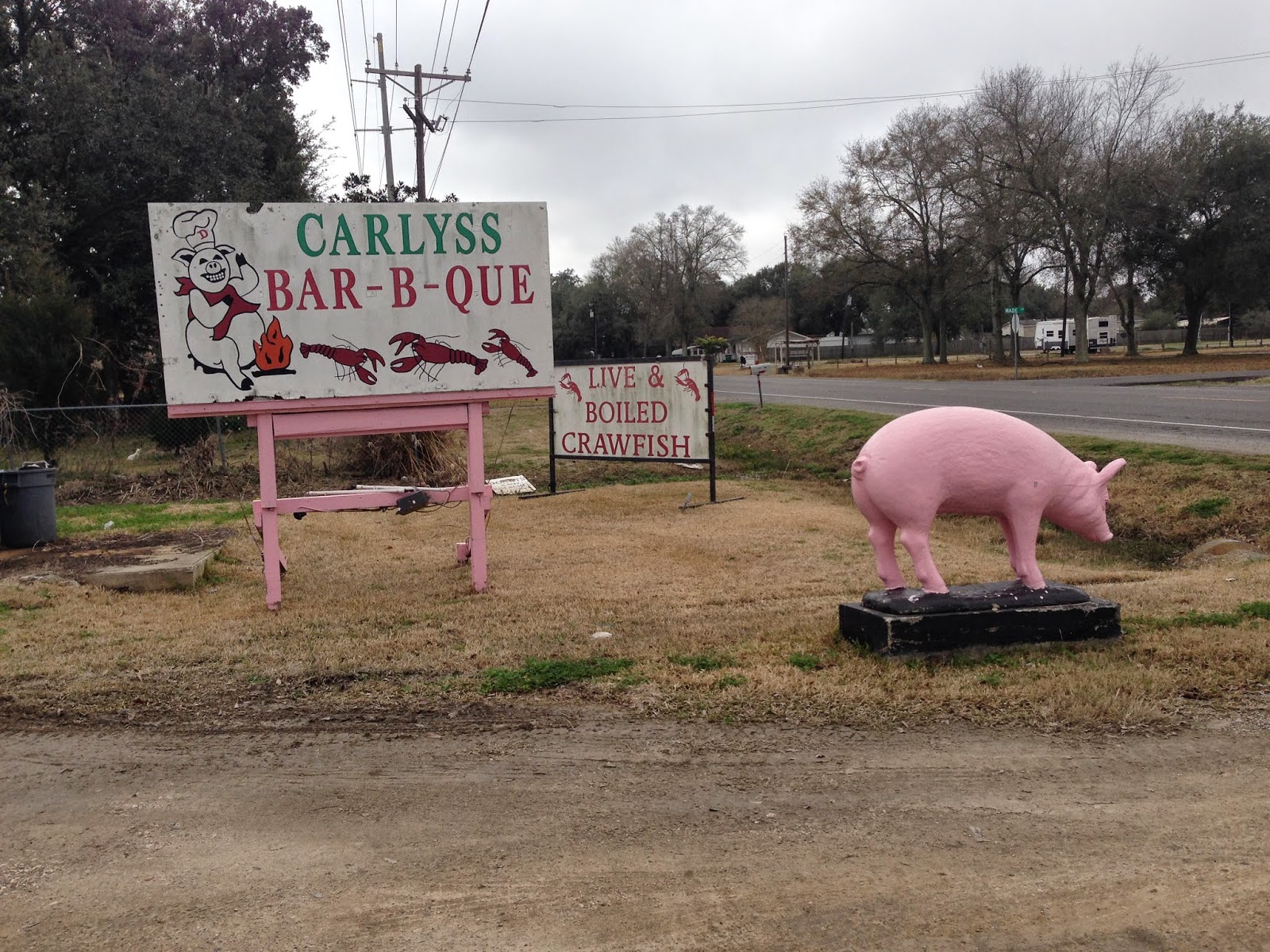
We pass the Carlyss barbecue and donut restaurant. What!?  Donuts and barbecue sold together? Foodstuffs (and I may be stretching the food concept here) produced using completely separate kitchen equipment? I worry that the restaurant just resells stale donuts purchased at Walfart the week prior. Amused by my petulance, the boys buy and enjoy hot, fresh donuts. I steadfastly pass on the donuts, long ago having had my fill of gluten headaches.  The boys enjoy the local scenery, snapping photos of the large concrete pig standing in front of the restaurant, the brilliantly pink mailbox, and the steer on the restaurant’s roof. Donuts, fake smiles and Prozac, where’s Paula Deen?  Perhaps lurking in the bayou.  I hear belches, but presume it’s the boys digesting the sugary fried dough rather than Paula.  Could the noise arise from Bloodroot’s intestines as he now complains about his alimentary canal?


We reach our first destination, the Sabine National Wildlife Refuge (NWR).  Established by Teddy Roosevelt in 1937, Sabine protects and preserves coastal wetlands for birds migrating using either the Mississippi or Central flyway. The refuge works to restore marsh habitat lost to rice farming, levees, channels and hurricanes. It serves as the nursery area for many marine species, including blue crabs and shrimp.  Sabine protects remnant beach ridges called cheniers and builds low-lying underwater terraces to replace lost cheniers. The cheniers slow wave action in open water areas and create yet another habitat for different bird food plants by giving them room to grow.  The refuge promotes the growth of native grasses via periodic burning, mowing and discing.  The resultant lush prairie provides natural beauty and protects the soil while supplying food and cover for wildlife.  Water control structures preserve a delicate balance between salt and freshwater.

Louisiana’s history-digging 8,000 miles of canals through the bayou to support the oil industry and building levees that dump marsh building sediment into the ocean has resulted in Louisiana losing an acre of bayou every half hour.  Since the 1930s, Louisiana has lost 1,900 miles of bayou to the Gulf of Mexico.  Looking at the increased hurricane threat to New Orleans, I would make bayou restoration a priority.  Sadly, I doubt that others share my desire.


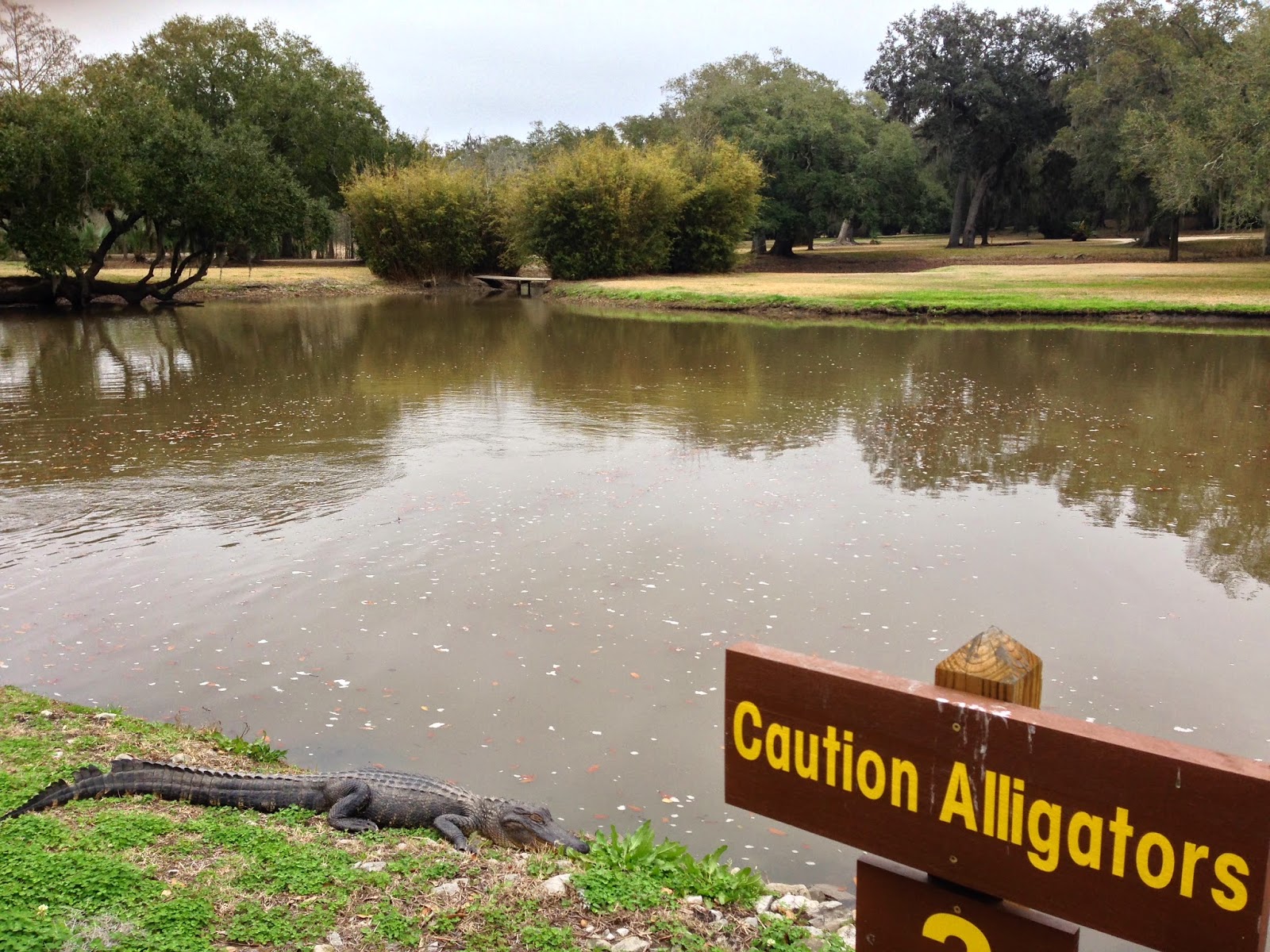
We venture out on the mile and one half wetland walkway boardwalk.  The early spring sunshine has brought out the gators.  My Denver buddies warned me that alligators could run real fast, catch and eat me.  I better watch out!  Researching, I learn that humans can outrun gators and that in any case, alligators don’t chase their prey.  Funny how we always fear creatures living outside our normal environment.  I wonder if Cajuns think that they’ll be eaten by bears or mountain lions in Rocky Mountain National Park.  These alligators appear pretty torpid, just out warming themselves in the glorious spring sun.  We later learn that today’s sunshine, the first in quite a while, has brought out far more gators than expected for this time of year. We see around fifteen!

On the boardwalk, we stroll out over the marsh, passing over both water and semisolid, somewhat squishy land.  Following Sven’s instructions, we carefully avoid the alligator poop.  “No poop on me or I quit!” he threatens.  We chance upon a languorous water moccasin, also sunning himself, and give him ample leeway as appearances can be deceiving!  We spot birds – herons, gulls, cormorants, egrets – Keith’s camera clicks and clicks.  We meet some real birders with spotting scopes. Ever jealous of other people’s lenses, Keith ponders his eternal dilemma.  Should he sell the house, leave the family homeless, and buy a few good lenses? Sighing at life’s verities and his own moral compass, Keith switches gears in his mind, taking out his frustration by using reeds to attack fire ant nests.  The ants swarm the reeds which Keith then brandishes like a little kid trying to scare me. So cute!  


Bloodroot takes us past Holly Beach, a vacation community chock-full of multicolored houses on stilts, right on the Gulf.  They’ll be able to combat global warming’s sea level rise with the stilts for a while, but when each house sits in sea water, albeit elevated, eventually the ocean, like the bayous, will win.  I hear no commentary from the ocean; it’s too vast to be concerned with a few houses encroaching upon its territory in Louisiana.

We take a working (free) ferry across a bit of the intracoastal waterway and cross some amazingly cool bridges.  To our chagrin, we see that Louisiana apparently doesn’t believe in picnicking.  For the past hundred miles, we’ve seen nary a picnic table or place to cook.  Our stomachs and our mouths both grumble.


Giving up, we head back north on eastern 27 to the Cameron Prairie NWR.  Stopping in the refuge’s parking lot, we prepare our luncheon salad, battling wind so strong that our lettuce takes flight.  We recover our salad bits for a nice lunch inside Pearl.


After lunch, Pearl ventures out onto the Pintail Drive Trail (part of Cameron NWR) winding through the bayous. As we spot so, so many birds, I fervently wish that I were a better birder and had a clue as to exactly what I am seeing.  But I must content myself by saying we see oodles of very cool birds. We drive past freshwater marsh, coastal prairie and moist soil. Much as Sabine, this refuge uses every tool at its disposal to create a smorgasbord of winter homes for thousands of birds, ducks and geese.   

Continuing north, Pearl takes us back to Lake Charles for dinner. Tonight Bloodroot proposes a new dining experience touted by young people on the Internet: haute cuisine fast food.  We seek a place called Sweet Breads.  I tremble, stomach tumbling within my body, fearing we will be eating fried pancreas chicken McNuggets.  Searching, we tour Lake Charles repeatedly.  Back and forth, back and forth we go, bickering through our hunger. Giving up, we return to our hotel parking lot for the wi-fi allowing Bloodroot to download correct directions.

Over dinner, I’m sternly corrected.  The name of the restaurant is Street Breads, not Sweet Breads. Bloodroot ridicules my pancreatic fears. At the counter, we order a glass of good, local beer and a sandwich made from artisanal bread and all fresh ingredients.  Enjoying our reasonably priced, local, well-crafted food, we reflect upon restaurant experiences as a whole.  Perhaps we’ve overrated the sit-down rigmarole  for decades.


Wednesday, October 1, 2014

Monday, February 17, 2014 – Nerd Heaven

We pack up and are out the door by 9AM.  Our first stop – Whole Foods.  Pearl has been getting louder and louder, courtesy of the numerous scrapes to her exhaust system.  She rides low, burdened by her hat, a 300-pound wheelchair, and the BraunAbility cripple conversion’s removal of reliable shock absorbers.  We are, unfortunately, victims of BraunAbility’s incompetent engineering, this being only the first issue we will have. For $27,000, BraunAbility didn't install heavy duty shocks.  I feel so ripped off. 

Keith crawls under Pearl as it gets real in the Whole Foods parking lot (Fog & Smog-Whole Foods Parking Lot).  A gentleman walks by, observes me watching Keith under Pearl, and this being the South, asks accusingly, “What did you do?” “Nothing! Nothing!  I swear!” I reply.  We both laugh.  Keith surfaces after praying to the automotive gods, as men are wont to do.  The gods don’t deign to answer us.  Pearl will just be loud.

Entering the store, we find Whole Food’s vegetable prices as irritating as ever; Keith will make no food commitments, and Bloodroot tries to be funny.  I boil over with frustration.  At long last, we collect enough food for a few days, spending $150.  I cringe, then realize that we spent $160 last night on utter crap.  Whole Foods at least sells real food.  We exit the store sans divorce, restraining orders or police involvement; a successful shopping trip overall.

Last night, Minnie asked us to stop by this morning to say goodbye to her on our way out of town.   She has freshly doused herself in a truly amazing amount of her headache-inducing perfume.  She wants to be pretty, and has dressed up for us.  I laud her efforts, understanding that she considers us important visitors and wishes to honor us.  During the two-minute ride to the drug store, Minnie’s perfume soaks into Pearl’s front passenger seat, where its fumey fingers will rise up to torture me for days.  Did I ask her not to wear perfume again?  No.  Do I have anyone to blame but myself?  No. We pick up her prescriptions and take her back to her apartment. We drive off heavy-hearted, wishing we could do more for her.

After dropping Minnie off, we drive out to the NASA Johnson Space Center, nerd heaven if there ever was one.  We buy our tickets.  A burly guard confronts us as we enter.  “Do you have any weapons?  Any mace?  Any pocket knives?” “No,” I answer, “we’re mellow Colorado hippies, made even mellower since we voted to legalize pot.” The big man laughs in a way that makes us think he has no moral qualms about smoking a bowl or two and waves us through.  “Mom,” says Bloodroot sotto voce, “you’re going to get us arrested.”

Years ago, as a child, I recall vacationing in Florida with my natal family.  As a budding scientist, I bubbled over with excitement.  I would be joining the Space Age at the Kennedy Space Center in Cape Canaveral. I would see the Mercury, Gemini and Apollo rockets!  My family cruelly crushed my effusive, enthusiastic fantasy by insisting upon visiting Disneyworld instead.  How could they possibly prefer tacky, expensive, fake kitsch to something really cool like rockets?  Reality splashed across my consciousness, her chilly fingers gripped my face, forcing me to see what I had so long denied. Deeming the moment ripe for confrontation, I faced my parents to deliver my familial coup de grace.  “You adopted me, didn't you?  You can tell me; I can take it.”  My parents, reasonably affronted, swore otherwise.  After some words, I admitted to being the spitting image of my father. Off to Disney we went, me pouting the entire way.  I still abhor Disneyworld.

With the current family, Disney isn't even on the map.  YES!!  We begin our tour of the Space Center with a tram ride.  Sven motors up the steep ramp just to prove that he can.  Manly men strap him into place at the front of the tram.  He’s excited too.  As a piece of technology himself, Sven looks forward to seeing the history of his kind.  By allowing me to choose my own fate, Sven has made our trip so much easier.  We are grateful. Thank you, Sven!

First tram stop - Apollo Mission Control.   The Space Center has restored all of its old desks and green screen monitors.  Remember the excitement of watching this on TV in the 1960s?  How many of us set our sights on science careers at that moment?  I sure did.  Coding software line by line on a truly primitive mainframe, NASA engineers guided the Apollo spacecraft to the moon.[1] NASA hired people straight out of college for the moon shot, believing the fresh graduates wouldn't have internalized the impossibility of their task.  Ascending the 67 steps up to Mission Control requires a young body or at least a physically fit one.  Now a tourist attraction, the Space Center has added an elevator, in theory reserved for serious cripples like me, although a few very large people join me in the lift.  Everything is bigger in Texas.


 Our next tram stop – Astronaut Training Facility.  NASA trains people in all aspects of space activity here, from piloting spacecraft to spacewalking to basic survival skills.  The astronauts work with the full gamut of space stuff from an old Soyuz capsule to the very latest in technology.  In simulated microgravity, people practice maneuvering large objects with robotic arms.  Gigantic things move easily in space, but don’t stop easily.  Damn Newton and his laws![2]

We reboard the tram for our last tour stop – the Saturn V Rocket.  The Saturn V, NASA’s workhorse, sent the astronauts to the moon.  Does anything else make a more grandiose statement purporting humanity’s power and hubris?  Here lies harnessed the ability to leave the earth, the home to which we have been bound from time immemorial.   I am awed.  With this rocket, we became gods, not particularly successful gods as we remained tethered to the earth by our body’s requirements, but temporary gods nonetheless.


 To escape earth’s atmosphere, Saturn V’s first two stages have five massive engines each.  Once reaching escape velocity by consuming the first two stages, the third stage retains one engine for guidance.  Longer than a football field (US football – 100 yards), the restored rocket has its own pole barn building.  We cruise around it, snapping lots of photos.

My parents, before a Saturn V rocket incinerated them - Bloodroot
We return to the main center.  Prominently displayed we find the old Star Trek shuttle craft.  What?!  Perhaps apocryphally reported to have been dumped in Paramont’s parking lot, some wealthy fans bought the badly battered prop, restored it and donated it to the Space Center.  Intrigued, we take more photos.  Paul poses in front of the shuttle.  Ok, I’ll admit it; Star Trek’s coolness factor far exceeds anything real.


Real stuff
Star Trek
Although currently working as one of the thirteen countries jointly operating the International Space Station (ISS), NASA plans to go to Mars in 2035.  I plan to be dead by then.  How odd that the most exciting thing of your youth outlives you to inspire the next generation.  Gearing up for the Mars flight, we’ve encountered some technical hurdles. People living in the low gravity of space lose 1.5% of their bone mass monthly, their spines expanding and hearts shrinking.  (In contrast, post-menopausal women lose 1.5% of their bone mass annually.)  The current antidote is lots of vitamin D coupled with massive resistance training.  Will we someday evolve into a race that lives only in space? 

Upon leaving, we discover that we've missed the moon rocks and the Apollo capsule.  Keith makes me promise not to tell the goat, as he’ll make us drive back.  I don’t tell.  Pearl takes us into Louisiana, our secret destination all along.


[1] Apollo didn’t have PCs.  Intel invented the microprocessor in 1975; PCs soon followed. For my serious nerd friends, you can build your own personal Apollo Guidance Computer in your basement.  Here’s the link: Build your own apollo guidance computer

[2] Law of Inertia:  An object at rest will remain at rest unless acted on by an external force. An object in motion continues in motion at the same speed and in the same direction unless acted upon by an external force.


Wednesday, August 20, 2014

Sunday, February 16, 2014 - San Antonio Missions, the Horrors of Houston and Aunt Minnie

Clothes washed, Bloodroot selects a white shirt and tan shorts for today’s adventures.  Keith calls him a Boy Scout, feeling the old scouting uniform best describes Bloodroot’s attire.

Our first stop today, the San Antonio Missions, consists of five separate missions spread around town.  (The Alamo Mission, yesterday’s destination, is one of the San Antonio missions.)  We choose to visit the San José Mission.  Exiting Pearl, Bloodroot, in his Boy Scout regalia, complains of cold.  Keith begins jumping around, gyrating as one stricken with St Vitus’ Dance, shouting like a small child, “Oooh, I’m cold!  I’m cold!” I can hear the unspoken, “Man up, boy!”  I simply watch, amused by the spectacle.

The Spanish built five missions along the San Antonio River, intending to create an indigenous medieval peasant society, loyal to Spain, of course.  The park service has restored the San José Mission.  In the early 1700s, gathering-hunting Indians, harassed by the Apache and drought, voluntarily sought sanctuary in the mission.  The price - conversion to Catholicism, loss of traditional lifestyles, and labor as yeomen farmers.  The choices were hard yet acceptable.  Unfortunately, most of the new converts died of disease.

The mission itself consists of a large walled compound.  We enjoy the stonework.  Inside we find workshops, chapels and living spaces for both the Indians and the Spaniards.  Gravity-fed irrigation systems watered the fields.  Initially successful, the missions began to fade around 1780, undermined by disease and lack of military support.  The missions finally closed their doors in the early 1800s.


We leave the mission heading for Houston and Aunt Minnie.

Bear guides Pearl up I-10 from San Antonio to Houston, four lanes all the way.  I curse this stupid state’s obligatory transit on lousy freeways.  As consumers loyal to big oil, we spend hours on the road, consuming lots of petrol while stuck in traffic on a Sunday.  We ride forever, enmeshed in major congestion all the way between the two cities, observing stranger behavior than we find in Denver, where we have the legitimate excuses of thin air and legal marijuana.  We’re accustomed to aggressive, clueless behavior.  Back home we watch people randomly changing lanes, or crossing five lanes of road to turn only a block later.   On this freeway, totally self-absorbed slow drivers block the left lane, meandering along, because naturally, no one else counts but them.  Mad hornets dash about determined to get around the slowpokes, providing some frightening entertainment.  Our tough trip, full of complete stops, makes me appreciate living in Colorado.  And Houston, East Texas in general, has the population to support mass transit!  We see no public transit, no light rail, no subway – just an interminable stream of vehicles.

For our edification and distraction, we listen to Bertrand Russell’s History of Western Philosophy.  Russell describes Plato’s Republic as a combination of Brave New World and Sparta.  Logically separated into three classes, governed by philosopher kings, everyone works tirelessly for the common good, eliminating poverty.  Russell’s audiobook could accompany you through four or five cross-country trips; I don’t think that you’d hear it all even then!  I doubt that we’ll ever get beyond Greece.

As we travel from west Texas to the east, I find myself liking the state less and less, my distaste rising with the humidity.  Houston smells like Florida, wet and moldy.  Have I become such an habitué of the high plain desert that I feel uncomfortable in the lowlands?  Already I thoroughly miss the thin arid air and find myself choking and gasping from the humidity, as though trying to breathe through a bowl of chicken soup. 

As we near the city, Keith calls Aunt Minnie, asking her what restaurant we could treat her to.  She suggests Dead Lobster.  “No!” we cry in panic.  Keith calls Minnie’s son Vic.  Since we’re near the Gulf, we hope for good seafood.  Vic suggests the Aquarium at Kemah.  Keith forgets to specify quiet and small.

We pick up Aunt Minnie at her apartment.  Six years ago, Minnie visited us in Denver.  What a difference a few years can make!  She’s gone downhill a good bit since then.  Me too.  In 2008, I walked and worked fulltime.  Minnie doesn’t look good.  Her hair askew, she’s missed her facial features when applying make-up.  Encumbered by cheap flip-flops, she walks unsteadily to the car.  She’s doused herself in cheap, foul-smelling, headache-inducing perfume attempting to cover her self-perceived sin of smoking. 

We find Kemah, which turns out to be an amusement park, loud, overpriced and definitely not for us.  We eat at the Aquarium Restaurant, an extension of the amusement park.  In search of a table, we pass numerous fish tanks and brightly painted concrete molded ceilings.  I fear yet another expensive, lousy meal.  The host shows us to our table.  We order.  Minnie happily eats shrimp.  I enjoy my snapper, ignoring the price.  The Bunny orders tilapia in pineapple salsa, which he later announces tastes like someone poured corn syrup over a piece of fish.  Keith also expresses disgust with his meal.  But Minnie dreams a heavenly shrimp-filled dream.  For $160, we have been taken yet again.

Over dinner, Minnie tells us that she’s dropped out of her church, her sole social support, because the Lutherans marry gays and Leviticus 18 calls homosexuality an abomination. I respond that Leviticus 11[1] calls eating shrimp an abomination.  My comment elicits a blank deer-in-headlights stare.  Ah Minnie, the central point of Christianity is love.  How can you not see that?  When asked the greatest commandment, Jesus reportedly said (as documented in Mark 12, Matthew 22 and Luke 10), “The first of all the commandments is, Hear, O Israel; The Lord our God is one Lord: And thou shalt love the Lord thy God with all thy heart, and with all thy soul, and with all thy mind, and with all thy strength: this is the first commandment. And the second is like, namely this, Thou shalt love thy neighbour as thyself. There is none other commandment greater than these.”[2]

Loneliness rolls off Minnie like a miasma, a palpable sadness you can see and touch.  I so pity her.  She was very good to Keith when he was young.

We drop Minnie off at her apartment.  Exiting Pearl, she again complains of lonesomeness.  Our visit has brightened her world, temporarily diffusing the melancholy which rebounds tackling her as we leave.  We promise to return tomorrow to take her to the pharmacy.

On our way to our very tiny Airbnb flat, we encounter yet more traffic at 8PM on a Sunday.  As Sven enters the flat, I’m stopped dead in my tracks by yet more overpowering cologne reek.  Oblivious to any safety concerns, we fling all the windows and doors wide open.  Bloodroot begins a seek-and-destroy mission, using his nose to save his mother.  Finally, he finds the odor’s source, a plug-in room stench machine.  He unplugs the machine, setting it outside in the grass to perform an appropriate function, like annihilating mosquitos or other unpleasant arthropods.  Mission accomplished, the boys dispel any remaining stink by creating tomorrow’s lunch, a tempeh stir-fry.  We settle in for our well-deserved sleep.


[1] Bible, King James Version, Leviticus 11:12:  “Whatsoever hath no fins nor scales in the waters, that shall be an abomination unto you.”
[2] Bible, King James Version, Mark 12:28-31.