Dramatis Personae

Dramatis Personae:

Keith, or Bear, a 61 year old male

Jody, or Beaver, a 57 year old crippled female

Bloodroot, or Goat, our 27 year old son

Bird, our collapsible manual wheelchair

Tinky-Winky, my walker

Thursday, November 24, 2016

Monday, October 12, 2015-Down to Madrid on Spain's National Holiday

Obeying Patricia, our San Sebastián Airbnb concierge, we stocked up on food Saturday as she insisted that nothing would be open today (Monday). Today reveals her claims to be completely specious. The fair continues. Perhaps Patricia believes that patriotism reigns supreme, but it doesn’t. For good or ill, money to be made harvesting the tourist trade overrules the symbolism of Spain’s National Holiday.

We gleefully note that many holiday visitors have already left Sunday to return to work tomorrow (Tuesday). “Yeah,” we think, “fewer people on the trains.”

After packing our remaining still-wet clothing (mostly jeans), we embark upon a two-hour whirlwind tour of the city.


We begin with the fair, enjoying the multi-hued booths open for business. Bear pushes Bird and me through the quiet streets before anyone else arrives. I see nothing I wish to purchase but enjoy looking. (Window licking, the French call it, but we have no windows. Don’t go there!) But if this really were the Middle Ages and I had one chance to shop all year, my attitude would alter and the merchandise would become much more appealing. I might be forced to buy one of everything! Oh no, no credit cards, cancel that fantasy.

Keith buys some doughnuts, freshly made. One bite of the anise flavored cake donut entrances him, my happy Bear. Delirious, he propels me down the streets out to the waterfront to look at the ocean. We see people attempting to sunbathe on the beach despite the cool weather. We find the aquarium, also not closed. We wander back in front of our house and get some coffee, tea and bad tapas at an open restaurant.

Back upstairs, Bear calls me to our balconies repeatedly to watch the fair unfold right below our flat. I catch sight of the medieval costumed people sauntering down the street playing antique instruments. I miss the more exciting acrobats, including the woman walking on a ball while jumping rope, preceded by a juggler, and followed by a man pulling a cart collecting donations.


I anxiously await a text from Bloodroot. As a mother, I find it impossible not to worry as my one and only massively beloved son flies in to Madrid from South America (Santiago, Chile). Seeking contact, I open my phone over and over again. I try to be discreet and unobtrusive as Bear will laugh at my worry. I fail; Bear teases me mercilessly.

Shortly thereafter, the landlady from our Madrid Airbnb calls asking for Bloodroot. Since Bloodroot will buy a phone when he lands, he currently has no phone number, and I can’t help her. She will look at his flight to see if it’s delayed and wait a while longer.

Meanwhile our taxi arrives to take us and all of our junk 500 meters to the train station. We engage in a hilarious quasi-discussion as my elementary Spanish deserts me and he “no habla ingles”.

At the station, we encounter our first (and fortunately only) amazingly nasty RENFE employee. The laziness of this woman defies imagination. All we need the bitch to do is walk ten meters and activate the battery operated ramp lifting me onto the train. She acts like I’m pulling out her eye teeth. We’re amazed as we’ve found the RENFE people bored and incredibly helpful as we give them something to do to relieve the monotony of clock watching. Not this puta. She first informs me, as I sit in Bird, that I can certainly ascend the three steps onto the train. We vehemently disagree, saying “Rampa, rampa” repeatedly. In her next attempt to avoid work, she badgers an English speaker into telling us that we needed to reserve the disability service 24 hours in advance and perhaps only through her goodwill she might condescend to help us. We begin to shout, “We were here Saturday and told to return 20 minutes early! What is the problem?” The English speaker rolls her eyes and tells her miserable co-worker to do her job. Señora Unpleasantness takes my name, ostensibly to call ahead, and with great reluctance loads me and Bird on the train. She refuses to assist with luggage, leaving Keith to trail behind us heavily burdened. Every other RENFE person has taken at least one suitcase in their free hand.


Unfortunately, today we have to manage two trains, the only thing I could find online (back in Denver) from San Sebastián to Madrid. After listening to Patricia, I was concerned that even RENFE would close today. This morning, RENFE’s website listed eight trains to Madrid today, all sold out. More unnecessary worry.

I don’t have too much trouble getting into my seat. The conductor stops by, insisting that we move Bird two train cars away and fold her up. Complying, Keith discovers the unoccupied handicap accessible spot where he feels we should be sitting in the first place. But RENFE will only let you sit in the seat you purchased. At times they can be kind and move us, but not today, as the holiday has left them screaming busy. I have a lot to learn before I book train tickets again.

Three hours later, a ramp meets us as we exit the train at Zaragoza, halfway back to Barcelona Sants. Gracious people move me and our stuff up one platform, through the ascensores, and down to another platform. We await the fast train to Madrid coming out of Barcelona. Sometimes I feel as though every train we take wants to send us back to Barcelona, specifically Barcelona Sants train station.

Personnel hustle us onto this train and abandon us with a chorus of “Baila, baila” (dance, dance). Actually, they say “Vale, vale” (OK? OK?). The fast trains have a very tight schedule, never stopping anywhere for long. We notice our seat numbers are 7A & B, halfway down the train. It’s 8:40 PM; I’m completely exhausted, but I begin to walk down the aisle as Keith holds my arms, keeping me upright. But my left leg will not move forward at all. This causes massive consternation among the other passengers. An incredibly kind woman and her daughter sitting in the last seat by the train car door jump up and trade seats with us. In our travels, we experience many random acts of kindness that earn our eternal gratitude.

Our first train took three hours to get to Zaragoza. This train, a high speed AVE (bird) train, flies along the tracks a longer distance to Madrid in an hour and 20 minutes. At Zaragoza, they’re so busy shoving us on to this train that they don’t really care where we put Bird, so we put her by the door. She’s happy to be near us, often frightened when she feels abandoned, folded up several cars away.

Every long train ride comes with a movie both dubbed and subtitled in Spanish. The conductors hand out ear buds that we never understand. But most people seem to find the buds easy to use. Viewing this film for the third time, we wonder how often RENFE changes films. RENFE began running the film before we boarded, so we only see the last part. The movie, called St. Vincent, stars Bill Murray. I note that Murray looks a good bit worse for wear. Keith says that Murray always looked scruffy.

At long last, Bloodroot calls, telling me that his plane crashed, stranding him in the Azores. Panicked, I momentarily believe him. Where did he learn to be such an inveterate smart-ass? Could this be his upbringing? Naturally, despite my motherly paranoia, his plane landed on time at Barajas, Madrid’s airport. He took a while getting across town in a new city but eventually found our new landlord. After receiving the keys, he settled in for a nice, long nap in our new Airbnb. We arrange to meet at Customer Service for handicapped folks in the Puerta de Atocha train station when our train arrives at 10PM.

When we pull into the train station alas, alack, no ramp greets us. Someone has dropped the ball! I suspect, perhaps unfairly, the nasty creature in San Sebastián.

This is how today begins to feel to us.


We watch in horror as everyone pours off of the train. No ramp arrives. I am stranded, three steps above the platform. In terror, I fear the train will just drive off with me on it. After what seems an eternity, Keith flags down three train conductors who stop and consider my predicament. They chatter in Spanish, reaching some agreement amongst themselves.

The three strong men approach my train car, hoist Bird and me, shouting uno, dos, tres and set me on the platform. The gentleman with the best English begins to push me while dragging one of our suitcases. Keith trails behind with the remaining baggage as we roll up to Customer Service. I learn the high-speed train is actually a German train, very long and strong. The conductor expresses great pride in the train. “It goes 300 kilometers per hour!” He continues in a different vein, “Madrid feels like and is a real city, unlike Barcelona, which is basically a tourist mecca.” He updates me on all the cool things to see in Madrid. I relate our planned Madrid itinerary and he approves.

He has visited the States seeing San Francisco, Las Vegas, and the Grand Canyon. What would those three places teach you of America? San Francisco, expensive yuppies; Las Vegas, addiction and tastelessness; Grand Canyon, beauty. So we’re a beautiful, expensive, addiction-prone people lacking taste. Perhaps correct, no?

The conductor delivers us to Customer Service, still open. In halting Spanish, I explain that we plan to meet our son here. No Bloodroot. The clock passes 10 PM, 10:15, 10:30. We call his phone as he calls us, but Vodafone does not consider our calls important and constantly drops them. We can’t get through. Finally our phone rings. Rejoicing, we hear Bloodroot’s voice. He’s been waiting by the Information desk where all the normal passengers file out as they exit trains. The boy never has listened. Handicapped people roll through secret ascensores to Customer Service. Drama resolved, Bloodroot greets us a few minutes later.

Bloodroot insists we need no taxi. He grabs some luggage and leads us to our little apartment, easily within walking distance.

But the drama of this day never ceases! The apartment elevator, probably once a broom closet, in no way accommodates Bird, though she considers herself a petite wheelchair. Indeed she meets all size requirements in the States where everything is huge. Here, she greatly exceeds elevator width. Bloodroot runs upstairs. Assisted by a nice neighbor, Miguel, he gathers a kitchen chair for my seat that does fit in the elevator. They send the elevator and chair down. The boys sit me in the chair. The elevator lifts us four floors. Success!

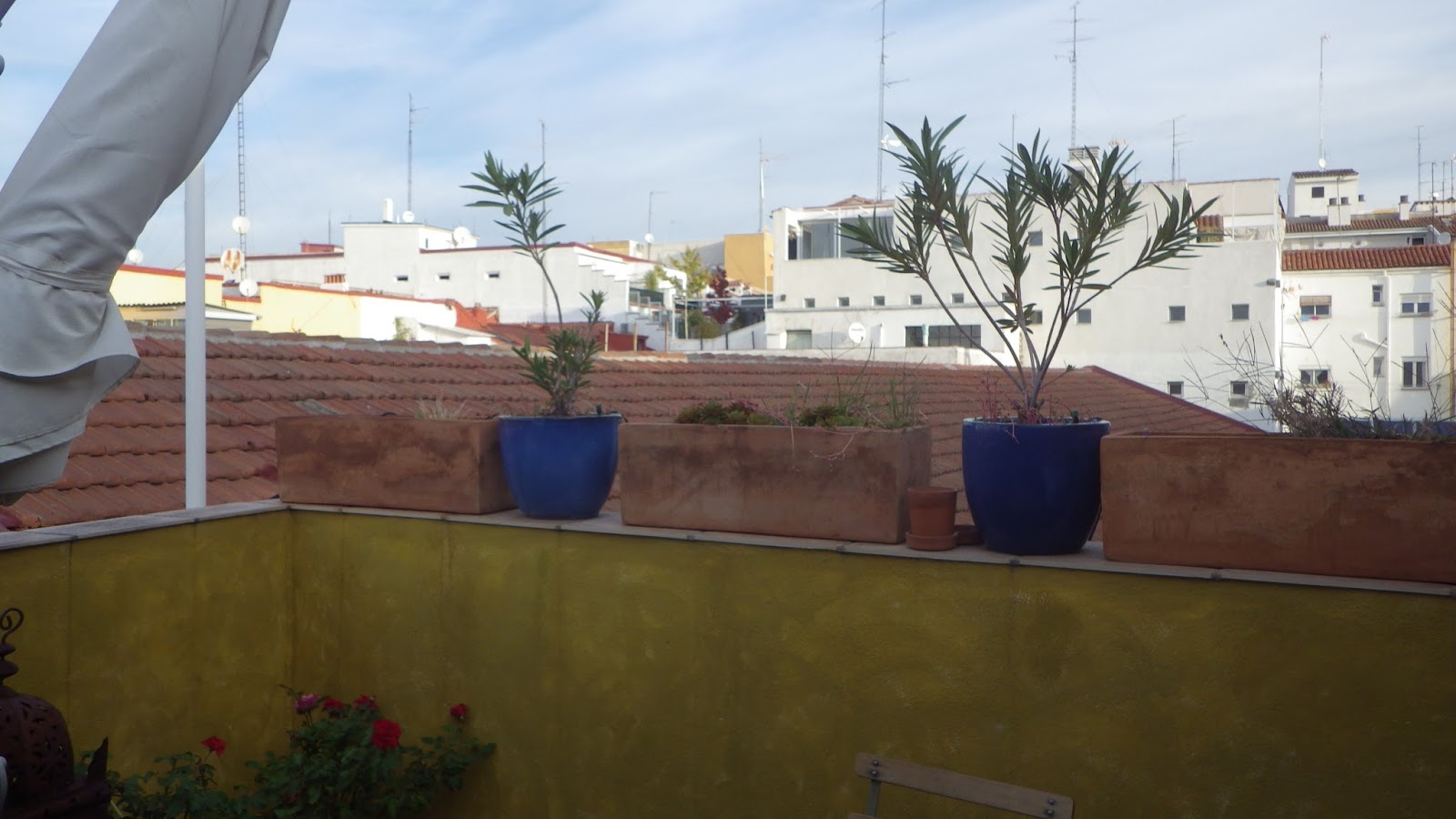
We enter our new flat. This flat has a full kitchen, including a dishwasher. We have a double bed on the floor, a kitchen table and a very, very tiny bathroom. I fear I will not be able to access the bathroom by myself. We also have a terrace upstairs, where Bloodroot sleeps. (Photo from a later day.)

Following a vocal animal greeting, Bloodroot tries to tickle Keith but to no avail. Keith squirms, but never giggles. He renames Bloodroot “Ticklehoof” the dancing goat.

We dine on the food we had prepared for the train. Concerned about both the elevator and the bathroom, we give Bloodroot the task of finding somewhere else to stay. He utilizes his computer skills, but fails to discover anything costing less than €250 a night. He finds nothing centrally located. Very late, 1 AM, we turn in for the night.


Sunday, November 13, 2016

Sunday, October 11, 2015 - Bilbao

Good morning, world! This morning, lacking yesterday’s hunger and crowds, San Sebastián already looks better. We begin today’s massive adventure by walking down to the Termibus station to catch the PESA bus to Bilbao. Contrary to everything on the PESA’s website, we don’t really need a reservation for the wheelchair. Spain long ago joined the European Union, so unlike the United States, all public transportation must be handicap accessible.

The bus, a touring ark, has a ramp in back that lifts me and Bird up to bus seat level. A secret door opens and in I roll. Only one fly in the ointment: the bus driver finds the ramp’s operation incredibly confusing. Were this accommodation not so vital to our trip, the situation would be hilarious. I don’t think that the bus operators encounter many cripples in wheelchairs. Eventually, with the assistance of other PESA workers, the driver lifts me on the ramp into the back of the bus. The scary ramp pops me into the air, a few meters off the ground. I pray that Bird’s brakes hold. Now I’m up with all the other tourists and I didn’t even have to walk up any stairs. The employees strap Bird’s wheels onto the bus floor. Lacking the common sense God gave a rooster, I don’t fasten my seatbelt.

Our bus charges out of the station like a freed stallion, off to Bilbao, an hour’s journey. I would call this another physical therapy hour as the bus careens rapidly down hills and mountains, eternally flying downhill, turning right then left following the curves of the road, amidst intermittent hard braking. I do my best to remain seated. We fly past the countryside, where heavy industry sustained Franco for so long. Strikingly beautiful vistas form Spain’s Rust Belt, just like the Midwestern US where both Bear and I hail from.


After a very scary hour, entirely my own fault, we arrive in Bilbao. Having left the Rick Steves bible at home and thus lacking easy directions to the Bilbao tram, we wander around a bit, in and out of a RENFE station, taking one ascensor down and another up. (We took the bus because Bilbao lies an hour away from San Sebastián by bus but two-and-one-half hours by train.)

We eventually find the tram, which, as advertised, cruises along at ground level, completely accessible. We ride the tram up to the Guggenheim, today’s destination ─ in truth, the entire reason for the side excursion to San Sebastián. Again, lacking our bible, we don’t cancel our tram tickets before we board but fortunately no one arrests us for our faux pas. Assuaging our guilt, we cancel the tickets as we exit the tram.

Despite my usual obsessiveness, I didn’t buy advance museum tickets in Denver. But we get a bye with the wheelchair. The staff wheels us to the front of the line and I purchase tickets at only six euros for Keith, free for me (€13 each regular price). Go figure.

The outside of the Guggenheim amazes us. The building itself, designed by Frank Gehry, lies beside the Nervión River.


We enjoy the larger-than-life outdoor sculptures. A pond next to the building contains a fog sculpture and a fire fountain. As could be expected, fog rises from the fog sculpture, producing a ghostly presence far cooler than it sounds.


We see a huge Jeff Koons sculpture of brightly colored tulips.

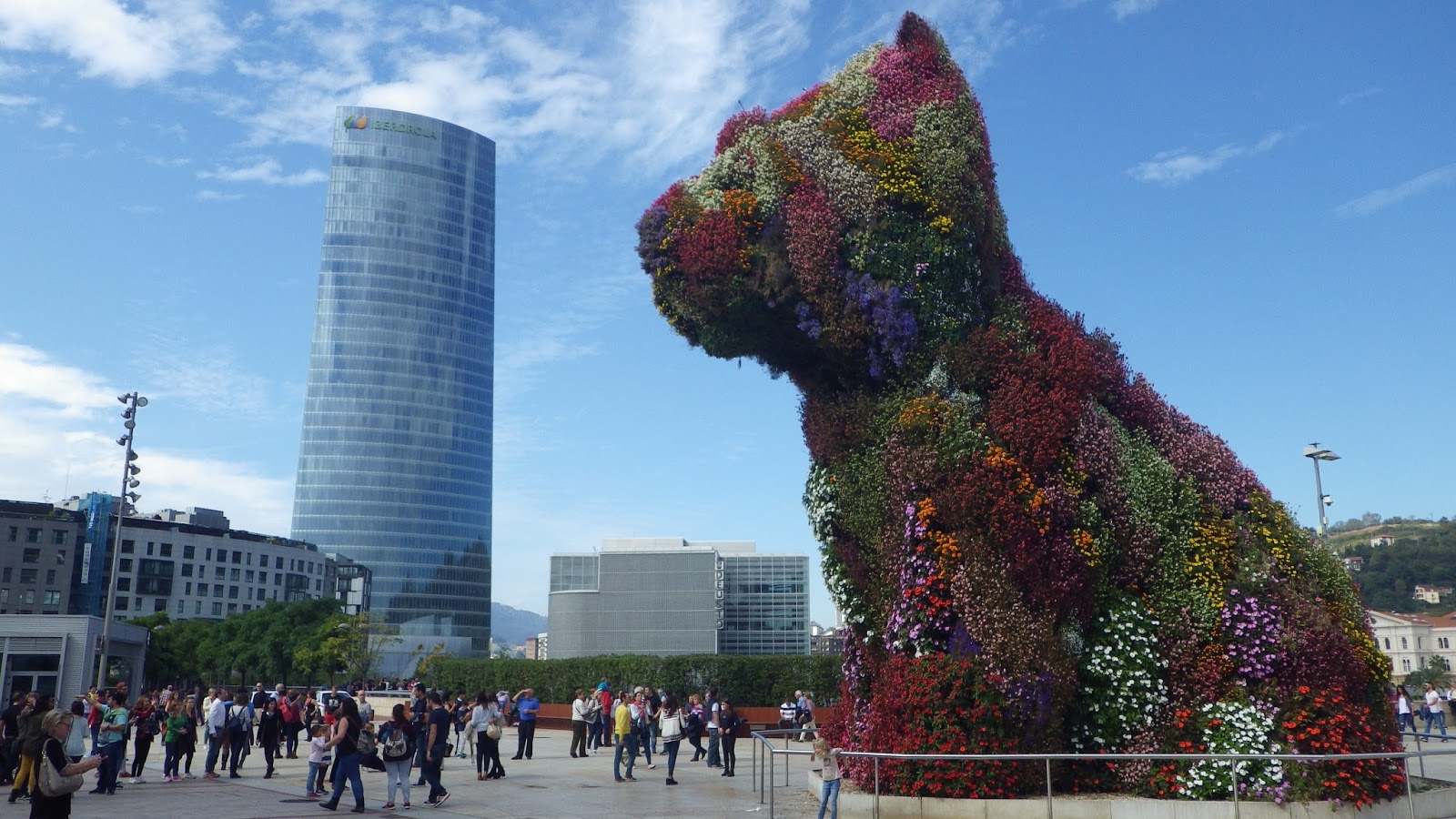
Bear spots a large topiary bear, also by Koons. We read the placard next to the bear and discover that it’s really a puppy dog. “You know you can be just too damn educated,” growls the Bear. I agree, I would prefer to have believed it was a bear made in honor of my bear.

We see a big spider and a tree made out of ball bearings. “Silver balls,” says the Bear.

But the inside of the Guggenheim severely disappoints. The three story museum dedicates the entire top floor to huge exhibit of Jean-Michel Basquiat’s work. Long ago, back in the States, Bear and I had watched a movie about Basquiat, so we look forward to seeing his art. Basquiat began as a graffiti artist, befriended and collaborated with Andy Warhol, rose rapidly in the New York art scene, and died at 27 from a heroin overdose. But looking at his work, I note no talent whatsoever. One of Basquiat’s often repeated quotes is “Believe it or not, I really can draw.” The exhibit provides no evidence of this purported talent. Bear grumbles, “I don’t like art that people have to explain to me.” I couldn’t agree more. Nothing moves me; nothing touches me. We exit stage right to the ascensores.

We attempt to descend to the second floor but find it closed, the elevator refusing to stop there. We learn that the second floor had previously been dedicated to a Jeff Koons exhibit that just ended. Bear feels I would’ve liked that. Lots of colors.

So down we go to the first floor. This floor holds a huge room full of humongous steel mazes. I enjoy hearing the kids squeal as they walk through the exhibit, their cries of joy bouncing off of the walls. Bird easily negotiates the enormous artwork.

Walking over to a darkened room, we find nine blue LEDs stretching from the ceiling to the floor. At first I am drawn to this art because, after all, it has color; it’s blue. Approaching the installation, the tickertape-like LEDs actually dissolve into words. Naturally I have to try to read them, which gives me a headache and makes me feel a wee bit nauseous. At this point, we escape the Guggenheim.

We walk along a grassy knoll following the tram tracks back to the bus station, a nice, peaceful and beautiful journey. Fortunately I have the Bear, because I would probably go the wrong way on the tracks, wandering witless like an ant without a scent-trail, and die. This digression ignores the problem that I am not ambulatory.

As we stroll along, we search for somewhere to eat lunch. We settle on a restaurant, Taquillas Guggenheim. We eat some mediocre tapas or pintxos and, far more importantly, partake of some wine and Advil.

After the wine, we think about having sex on the street. We find Bilbao so quiet that the imp of perversity encourages us to stir the place up. Can you imagine, a cripple arrested for fornicating in public? Bear feels he needs time and more wine to devise some sort of contraption with levers and pulleys. “I think it would be more like block and tackle,” he says, “especially if you’re on top.” Eschewing the fantasy, we leave the restaurant and continue our walk to the bus station to await our return bus. I booked a fairly early bus back, 16:00.

This time we board a brand-new bus. This driver understands his lift and loads Bird and me without any difficulty. Unwilling to disturb his shiny new bus’s pristine look, he refuses to pick up the rubber strips lining the tie-down area, leaving the wheelchair unattached to the floor. I lack the intellect and language skills to argue. For the return trip, having been trained up right, I do buckle Bird’s seatbelt.

On the bus ride back, the bus caroms uphill which slows it a bit. I doze a briefly, rudely awakened by Bird’s movements. Although securely braked, we begin to fall into the middle aisle. I desperately call Keith, interrupting his nap. At every curve Keith must hold Bird down to keep her from flipping over into the aisle of the bus. What a bunch of morons (us included)! And I lack the Spanish language skills necessary to even explain their idiocy and fuss at them.

We employed great effort to get up here to visit the Guggenheim Museum. I found the museum pretty sucky and feel depressed about the waste of time and money; Keith isn’t. He feels that everything we do has value. He had a good day; he enjoyed the museum. “It’s not the best museum but I enjoyed the adventure.” I envy his easy, eternal joie de vivre. Thinking carefully, I agree with Bear. Had we not been chasing the Guggenheim, we never would have visited this lovely corner of the world.

Returning to our apartment, we find the fair still burbling below our balconies. No longer dazed by hunger, we enjoy the human tapestry dancing beneath our windows. Keith goes out and wanders through the fair while I nap. He likes the crazy musicians, the wandering minstrels. Happily, he buys some walnuts and apricots and dates, real Bear food.


Yesterday he washed almost all of our clothing and much of it is dry. For dinner he cooks nearly all of the food we bought yesterday in a chicken stir-fry with noodles. Bear’s culinary skills bless us once again! 

Saturday, October 29, 2016

Saturday, October 10, 2015 - San Sebastián or Donostia

Finding the washer still locked this morning, we abandon the wet towels inside it as we have no choice anyway. We leave the flat’s keys on the table and descend to our waiting taxi, the driver having arrived just as promised. He takes us and all our junk to Barcelona Sants. For disabled loading, the train people want us there an hour early. For a 7:30AM train, this translates into a 6:30AM appearance at the train station. In the early morning hours, Bear forages, gathering tea for me, coffee for himself, accompanied once again by bad cafeteria train station quasi-food.

Slightly before 7:30AM, the RENFE people load Bird and me onto the train. Our adventure begins! The train leaves the station, heading northeast. Wouldn’t it be cool if trains still chugged? Probably not, those coal engines really stank and blew soot everywhere. Ah well, so much for romanticism. Aboard, gazing out of the window, I watch the terrain change from gentle Mediterranean seaside to harsh endless desert. A few green fields pop up, fed by irrigation, the only green for miles in any direction. A misquotation of My Fair Lady floats through my head “the rain in Spain does NOT fall mainly on the plain”. In the rather early morning, Bear slumbers contently. After an hour or so, while he snores, olive trees dominate the landscape, grove after grove after grove of them. Leaving the olive trees and desert behind, we approach the Atlantic through the mountains of Basque country. The scenery becomes gentler and green, much greener. The train continues onward as the land rises, while the hills roll with pretty deciduous trees. After all of the hustle-bustle of Barcelona, we look forward to a quiet, relaxing weekend by the sea.

We arrive in San Sebastián around 1 PM. A very kind English-speaking RENFE employee escorts us from the train into a very small station. He tells us to arrive twenty minutes early for Monday’s trip down to Madrid. He then calls a handicap taxi cab for us. The cabbie, another Anglophone, delivers us near our Airbnb apartment.

Patricia, the Airbnb manager, meets us on the street. The taxi can’t park in front of the apartment because a huge street fair has monopolized all space in front of the flat.

Pushing our way through the fair, we gain and enter our temporary home. Wow! What a nice place! We have real wood, with everything easily large enough for a wheelchair, for good or for ill: smaller places often have more things for me to grab. Unfortunately, I then may encounter the problem of pulling things off of the walls. Details!

Patricia talks to us for about an hour, telling us all the good things in San Sebastián. I ask if the Basques plan to secede from Spain as the Catalans voted to. She sighs, replying, “All the money is up here or in Barcelona. Madrid will never let us go. Down south, they have 50% unemployment.” How do you run a country with 50% unemployment? (Fact checking, I find Spanish unemployment rates for all adults high, 25%, hovering around 50% for younger folk in the 15 to 25-year-old range, but pretty much the same throughout the country.) “The worst part is that we have to pay for the monarchy. No matter how badly they behave, they’re untouchable. We can’t even sue them.”

Patricia also gives us washing machine instructions in English! She, in fact, has a laminated sheet explaining each and every appliance in the apartment, in English. She claims that street fairs constantly occur, part of the price of living in a major tourist area. She strongly suggests we buy food and whatever else we want at the grocery store today, as she fears all will be closed for Monday’s huge, all-consuming holiday. Monday is Columbus Day in the States (no biggie here), but Spain’s National Day and very important to Spain.

Keith begins laundry, although annoyed that no one in Europe seems to have a dryer. Dryers may be considered major energy hogs and frowned upon. That’s my theory at least. Our multiple electric stoves denote a lack of natural gas.


Our apartment feels like something out of Romeo and Juliet. We open the large window doors, step onto the balcony and look at the people in the street below. Juliet could declaim her sorrow from this balcony. I’m not sure that Romeo would hear her over the noise of the crowd. Today, she would require amplification.


But we have let ourselves get too hungry, a major problem with MS. I must be fed, watered and nap regularly. Keith adds that he needs to change my nappy. Attempting to avoid feeding-time-at-the-zoo problems, we go out to find something to eat for lunch. Unfortunately, we encounter the entire population of Spain joining us here for the holiday. Forward! We find the grocery store and purchase supplies for the weekend. We take our prizes back to the apartment, where Bear puts them away.

Then we resume our search for lunch. Following Patricia’s recommendations, Keith walks back and forth between two equally stupid places to eat, neither of which has an open table. Forty-five minutes later, we wander farther down the street and find a spot selling some really bad wine and bad American food. We avoid the hamburgers and chicken wings. Gag me! We accept the wine, hoping the alcohol will mollify our desire to kill all the other tourists and/or each other.

Ravenous, we roll over to the old section of town hoping to find bars with good food. However, we find nothing even vaguely handicap accessible, as all places have very tall barstools. Homebound Sven, back in the States, has a motor that can lift him up in the air to barstool height, but Bird does not. Bird expresses her jealousy and disgust that we would even think of Sven when she has worked so diligently on this vacation, sacrificing even her wheels, which were fine before but now make scary noises. She’s become arthritic aiding us! When our appliances begin to bicker, we always lose.

We seek the famed pintxos, the local tapas-like delicacy, and special food of the region. We find only massive dough balls. Aside from the dough balls, most bars feature bad American food accompanied by bad American music. For some reason we have to listen to the shit hits of the past 60 years. So on top of being ridiculously hungry, I also have the joy of having “Proud Mary” earworming its way into my head. And unlike the Spaniards, we can’t avoid knowing every fucking word and its theoretical meaning.

So we wander and wander and wander in search of food, Bear finds nothing acceptable. One place has too many people. Another too much sunlight. Another too close to the road. We struggle mightily with hunger and spacing out. We finally find some mediocre food resembling tapas. (Pintxos perhaps?) These tapas seem to be either dough balls or mayonnaise balls. I down a couple of mayonnaise balls to keep me going.

From the second we arrive in San Sebastián, Bear begins to complain, “We don’t have enough time here,” although he personally approved every bit of our itinerary. Thus far, this place sucks so badly, I’m fiercely glad we’re leaving Monday. If I lived in Europe, I would probably like to come here for a holiday but as it is, we find only a horribly heavily overly-touristed spot with nothing really to recommend it.

The streets change names repeatedly. Keith gets lost so often that I ask if he has had a stroke. “No!” he responds vehemently. But I get a big star today, because I direct us home after Keith turns himself around for the 35th time. My red letter day marks the first time in our relationship I know the way somewhere and Keith doesn’t. This has never happened before and will probably never happen again. Keith now denies that this happened at all.

Upon returning to the house, we look at recommended restaurants, which I printed out in Denver and brought with us. After complaining mightily about the crowds in San Sebastián, we decide to go out and have a nice dinner. We seek a place lacking Michelin stars. (I knew the woman who edited those books and am not impressed.) We choose a restaurant called Ikaitz on Paseo Colon. I look up directions on Google Maps, but type in the wrong street, which I nonetheless proudly direct Bear to. Whoops! I am a bit spaced, thanks to starvation.

Lost again due to my stellar map reading and navigational abilities, we search for the restaurant. Numerous very friendly, helpful people direct us to the eatery. As early diners, (8PM) our lack of a reservation doesn’t preclude a table and we’re invited in. (Mom told me of the lines of old people waiting in the Naples, Florida restaurants at 4PM. Are we becoming the same old people? Would we admit it? NO!)

Our first dish, a flower created from asparagus and red lettuce leaves, looks nearly too pretty to eat. But we are Neanderthals, starving Neanderthals, so I will report that we devour the beautiful flower, finding it absolutely delicious. We split a bottle of good wine, which also greatly soothes our spirits. For our main course, we divide an order of monkfish jaw, the best food of our entire vacation. We finish with a sumptuous dessert.

As we finish dinner, the hordes with reservations begin to arrive. Many appear to be older men with younger women. ¿Las otras? (The others, or mistresses) I wonder. Am I primed to see this by the intra-lesson gossip of my devoutly Catholic Spanish tutor? Is this the legacy of a country that was once so highly Catholic, with divorce forbidden? Per UN statistics, Spain’s current divorce rate of 61% exceeds ours of 53%. Or are las otras the cause of the high divorce rate? According to many observers, Spanish Catholicism encourages mistresses ─ with no sadness involved due to wide acceptance, even by wives.

Returning home after dinner, we find the really tacky street quasi-medieval fair continuing outside our windows. The massive throng of people prevents Bird and I from even seeing the fair. “It’s not that bad,” says Bear. We like the fair a lot better on Sunday when it features fewer people. On Saturday we find it merely really annoying. “Just too many fucking people.” We go to bed.


Sunday, October 16, 2016

Friday, October 9, 2015 Tarragona

Today we have train tickets to travel down to Tarragona, an old Roman town lying about an hour southwest of Barcelona, along the Mediterranean. Now that we’ve been trained up right, we find the Sants train station without incident. We arrive in due time for RENFE workers, using their magic ramps, to help me onto the train.

Arriving in Tarragona, we disembark, then leave the train station. As Keith wheels me out, we’re greeted by two women from the local Barcelona TV news station. Hearing our speech, they believe they’ve found a couple of English people. We often find ourselves considered English as Spanish speakers can’t distinguish between an American accent and an English one. The English would be so insulted. The women ask us if the Spanish train service and disability assistance rival or outperform England’s. I respond that I don’t know as I could still walk when I visited England 15 years ago. We praise RENFE as people have been so incredibly kind and helpful. But we regretfully report that in America we have no trains (except Amtrak, which doesn’t really count). Also, as my compatriots know, we live in a country so vast that we fly over it, or drive our cars for shorter distances, leaving us no real comparison. Our country has invested in freeways, not trains. All in all, we provide little help to the reporters. Their quest continues.

We begin our Tarragona visit by exploring an old Roman stadium. During Roman times, the authorities would fill the stadium with water from the Mediterranean and stage mock sea battles. The Bear happily wanders all over the ruins. Finding no berries, he returns.

Bear pushes me uphill to the top of town. Up, up, up we go, very hard on Mr. Bear. Although perhaps he could stand to lose a few kilos, poor Bear has already shed all additional weight he needs to relinquish by pushing me about.

After gaining the top of the hill, we stop to visit the Archaeological Museum of Tarragona. The story of an English ship named Deltebre I consumes much of the first floor. In 1813, during the Napoleonic wars, the British wanted to cut the Peninsula in half, eliminating Napoleon’s supply routes. To do so, they laid siege to Tarragona, but failed. After lifting siege, before sailing away, the Brits beached or deliberately sank any unneeded vessels, denying Napoleon their use. The museum has salvaged part of one convoy ship and placed it on display, along with its story.

Museum Outside

Going upstairs we find very cool busts of nearly every Roman Emperor. We stop and say hi to Claudius, my favorite Roman Emperor, due of course to the I Claudius television series. Next, we see some great Roman mosaics, including two of Medusa, and a peacock.  We find a stairwell enveloped by the mosaic of a hunting scene.

Leaving the museum, we seek our lunch. We find a stellar spot right across the Plaza. Using incredibly fresh seafood, the restaurant crafts one of the best meals we have in Spain. We order an amazing lobster dish. We watch the table next to us devour enough food to feed someone for three days. And they aren’t fat. Do they just have their big meal at noon? Or perhaps, given the cost, do they only eat once every three days?


After our memorable lunch, we visit the cathedral. Various peoples erected holy edifices in the same spot, the church merely the latest incarnation. Initially the Romans constructed a temple either to Jupiter or Augustus, supplanted by a Moorish mosque. Following the 1492 Reconquista, locals built a basilica. As I had promised, I say a prayer and light a candle for my Spanish teacher Irma, who back in the States prays for me. The cathedral has numerous chapels dedicated to various saints with the Virgin enshrined as the best saint ever. We wander through the church enjoying the various chapels and the architecture. 


Near the cloister, we find a museum of the Diocese, all descriptions in Spanish, that I can’t honestly say we understand, but a door from there opens onto a most delicious courtyard filled with fountains and trees. What in the world is a diocese anyway?

Following our cathedral visit, Bear wants to explore the city further before returning to the train station. He hands me the map of Tarragona. Stopping for a minute, I orient to the map, pointing out our whereabouts, and putative path, based upon his desires. Bear says, “This way looks interesting.” With that, he charges off in the opposite direction to the one I indicated. While still pushing me about, he continues to ask our location. I quickly give up, having no idea whatsoever. Eventually, we find ourselves lost on the main drag, another Ramblas, turned around going exactly the opposite way from what we intended. Nice helpful people explain our location, and how to get down to the train station. We attempt to heed their advice, but everywhere we go we encounter more “fucking steps.”

Admitting defeat, we follow the car route to the station, neatly avoiding the “fucking steps,” as we know cars can’t take stairs either. We reach the train station in the nick of time and return to Barcelona.

With bittersweet nostalgia we acknowledge our last night in Barcelona. After 10 days, the city feels like home. We grab a late bite to eat one more time at the Gent del Barri. Turning in, we reflect on how much we like this place but realize our age precludes moving here. With aging, comes a respect for, or at least a grudging acceptance of, the necessity of big spaces that accommodate power wheelchairs, grocery stores, and cars.


Saturday, October 1, 2016

Thursday, October 8, 2015 Barcelona History Museum, Parc Guell & La Pedrera

The washing machine runs yet today. Boy, those towels must be clean! Keith manages to stop it by pushing some other buttons, different from the ones he mashed yesterday. The door remains locked with the contents inside, sopping wet.

Today we will find the Barcelona History Museum. Armed with the correct address, the correct directions and the strength of our obsession, this should be a breeze. The museum’s website lists our desired museum as one of ten city museums, causing mass confusion, but today, we head to the indisputably exact location. Onward!

We also feel we have mastered the Metro. Exiting the Metro at the absolutely correct location, we ascend to the street without encountering any “fucking steps.”

We begin our search for the museum. It should be right here, but no! We follow signs directing us to the museum. Before we reach our quarry, the signs disappear.

We can’t find this darned museum to save our souls. I ask passersby, “¿Donde está el Museo?” I have to learn to stop asking for directions in Spanish because I don’t understand the responses.

We begin to wander. We choose a direction and end up out on the Ramblas. Seeing some policemen, we decide to ask them for directions. They do know the museum’s location. They instruct us to return to the Plaza Jaume I and make a left. We obey, but to no avail! We still can’t find the museum and begin circling a church.

Ahoy mates! At long last we find the museum, back in the alleyway hidden behind the aforementioned church we’ve been circling, the museum’s location not even vaguely intuitively obvious. Should we blame Spain? Perhaps if you have to go through a church on your way to an infidel museum, you’ll stop and pray, which will help your soul’s journey through purgatory. Barcelona does us a favor for the future.

This hidden history museum proves well worth the effort. Augustus (as in Roman Emperor Augustus) conquered the area as a breadbasket and winemaking region for Rome.  We ride an elevator down 65 feet to end up at the level of the Roman city called Barcino. Barco means boat in Latin and Spanish so perhaps the early name of the city was little boat. Catalonia has changed hands and rulers innumerable times, but the Roman time feels happy and prosperous.

The museum preserves a working-class part of town where we explore Roman streets, walls and a laundry. The laundry had several different buildings, one for washing, a second for bleaching and a third for dyeing. We find the ancient ruins far more intuitively obvious, albeit in action undoubtedly smellier, than our flat’s washing machine.

Aside from the laundry, we see the remains of a factory that produced garum, a fish sauce big in ancient Roman cooking, actually a high status item. The manufacture of garum begins with fish blood and guts, salted then fermented. The entire process looks pretty gross to me. Can you imagine the stench? Between the rotten fish and the urine collected for the ammonia content (used to bleach the fabrics) the odor would have bowled you over! Not a fan of heavily salted rotten fish in any permutation (especially including lutefisk), I’m grateful to not have lived during the Roman Empire.

We leave Rome to the Romans and we find an inaccessible medieval church that naturally I can’t see. Keith ventures into the church to work on his soul. Fortunately I’m not expected to pray for him, or the poor boy would be in eternal deep doo-doo.

The museum has more rooms upstairs. A guard working a lift invites us to venture through them. Unfortunately, we’ve once again run out of time. We leave the museum.

We walk out to the Ramblas, descend into the Metro, and reemerge up by Gaudί’s Parc Guell. From the subway we have a fifteen-minute walk uphill to the Park. Keith labors, pushing me. Huffing and puffing we arrive at the park just before our allotted time of 4 PM. (Keith huffs and puffs. Sitting in Bird, I merely look strained.)

Parc Guell, Gaudί’s failed attempt at a high-end gated community, feels rather like Disneyworld as no one ever lived here. Our 4PM timed tickets grant us entry, and like Disney’s tourists, by this time we find ourselves overwhelmingly famished.


Immediately inside the park, we find a small restaurant filled to the brim with pigeons, far more pigeons than tourists. I easily find a seat under an umbrella on the outdoor patio. I see only a few other diners, not a good sign, but observe myriad pigeons lurking, perched on the umbrella tops.

Keith enters the restaurant seeking wine and something edible. In his absence, a family with a smallish child abandons their attempts at consuming the quasi-food, leaving the table strewn with French fries and bits of what may at one time have been a hamburger. Immediately, ten or so pigeons descend in mass, frantically gorging themselves on the discarded child’s lunch, providing a spectacular show. Other diners don’t share my pigeon tolerance or enthusiasm. A neighboring table full of Germans rouses themselves, shoes away the birds from the now vacant table and takes the offending tray indoors. So much for that entertainment!

Keith returns with two glasses of wine, having examined the food offerings. He finds the so-called food so bad that he dismisses the idea of any culinary purchase. As you know, bears will eat anything that doesn’t move faster than they do, so the food must truly be atrocious. We drink the questionable wine, not even vaguely tasty, but at this point we seek only the alcohol content.

Fortified by wine, we begin our exploration of Parc Guell. Up, up, up we walk. Poor Bear never gets a break. I just hope his wheelchair-pushing muscles prove useful for this upcoming year’s skiing. We enter a hall of columns. Gaudi intended this to be a market for his upscale development. Gaudί topped each of the eighty unique columns with a rainbow of broken crockery pieces. From the top of the hill, we can see the city of Barcelona in the distance.


Now we descend back down to the bottom of the park ending up below the outdoor room with the columns. Looking up the grand staircase leading back to the proposed market, we see Gaudί’s iconic Dragon statue perched in the middle of the staircase. Guards chase away any children and/or tourists who attempt to touch the dragon, preserving it for both us and future generations to enjoy.

We also see Gaudί’s wonderful ironwork and fences, stuffed here and there. He copied his dad the ironworker, never losing his delight in the medium. We wander up, down and around ending up by the porter’s house near the entrance. Gaudί built the porter’s house for working people, his only design for people of lower classes. The guard there welcomes us inside but we want to finish yesterday’s interrupted La Pedrera tour, so we politely decline.


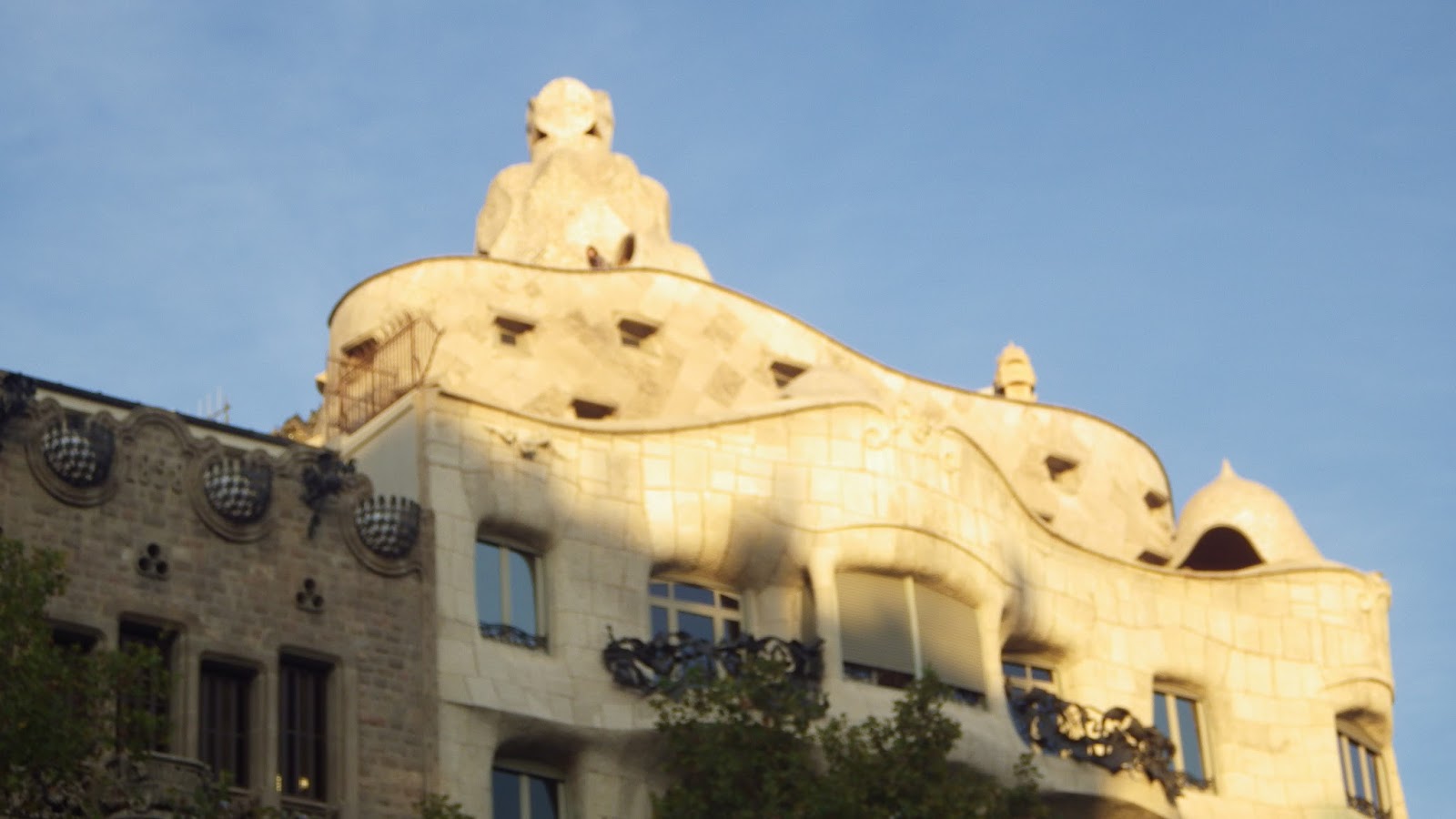
Leaving, we take the Metro again, exiting on Passeig de Gracia near La Pedrera. Approaching the entryway, we note that our tickets from yesterday are still good. The La Pedrera employees didn’t lie. Once again, the employees open the big door allowing me to enter the building. We love Gaudi’s apartment building. The original locals didn’t, naming it “La Pedrera” or “the quarry” as an insult. The movers and shakers of the day felt it looked like a strip-mine and didn’t hesitate to voice their disdain.


Keith snaps a photo of me in front of the big door. He claims to have added an “intelligence program” to his camera. Purportedly, the software helps me to not look quite so imbecilic in every photo. I’ve never been photogenic; we still have to delete a lot, grateful that the film era has passed.


Inside the apartment, Gaudί created a very nice courtyard. I scoot around the room gazing at the pretty steps leading upstairs and into the building that, of course, I can’t negotiate. Little palm fronds and a beautiful decorative bannister grace the stairs.


I roll over to the elevator, ascending to the attic. We begin our tour where we left off, having been evicted during the yesterday’s evacuation. Today from the guards we discover that unrelated construction yesterday required eliminating electricity to the block. Mystery solved!

Currently the attic houses a museum mostly about Gaudί. Gaudί designed many of his buildings by hanging string between different features upside down. The string would of course find the resting place of least resistance, draping itself where it should fall. Gaudί would then turn his models over and know exactly where to place each support as well as how it would look.

We discover that there really wasn’t much of the attic we hadn’t seen the previous day. We finish up the museum, taking the elevator back down to floor zero. From the first floor we will take a separate elevator up to the apartments set up for the tourists.

But oh no! Bird won’t fit in the elevator. We’re confronted with yet another minute elevator and our wheelchair, while small for America, apparently isn’t for Europe. The staff kindly lends me their wheelchair which does fit into the elevator. We ascend.

Upstairs, we tour two apartments set up as they would’ve been in the 1910s for wealthy residents. We see a maid’s room, a kitchen, a dining room, living room, bedrooms and a bathroom with all the modern accoutrements of the day. This means a bathtub and running water.

After ruminating about how people lived with ridiculous amounts of money in the 1910s, we wander back downstairs. We collect Bird and roll over to the gift shop. I’m no longer allowed to buy magnets or coffee cups, so I buy a pillow cover designed by Mucha for €50. The cover we buy features a woman named Amethyst, a beautiful Art Nouveau diva. She now adorns our living room, providing a wonderful memory of our trip.

In the La Pedrera gift shop, Keith asks an obliging guard for restaurant recommendation. He recommends El Almacen, a restaurant not too far from La Pedrera, on our way home.

Leaving La Pedrera, we stumble out into the darkness. We consider visiting the block of discord (Casa Batilo), another Gaudί highlight, but it’s dark. We plan instead to see Casa Batilo in the daylight of another day.

Also, our bodies complain loudly. We had no lunch. We ran halfway around the city subsisting only on our standard hearty breakfast. We opt for the recommended restaurant. At El Almacen, we enjoy some wine and some food, good but not stellar.

Leaving the restaurant, we head back toward our flat. Keith decides that we will walk, not take the subway. We get lost or “turned around” as he says. (Bears never, ever lose their way. Or at least, they never admit directional defeat.) Suddenly Sagrada Familia jumps into view. We now know our location! Keith snaps a few photos of the famed church at night, seeing it in a whole new light or perhaps more accurately, a lack of light.


Today has been another mega-touring day. Although I repeatedly promise that the next day will be easier, somehow this never comes to pass, and we will become more and more tired over the course of this trip. But for tonight, we find our flat and turn in for the night, grateful for our comfy bed.