Dramatis Personae

Dramatis Personae:

Keith, or Bear, a 61 year old male

Jody, or Beaver, a 57 year old crippled female

Bloodroot, or Goat, our 27 year old son

Bird, our collapsible manual wheelchair

Tinky-Winky, my walker

Thursday, April 30, 2015

Saturday, March 1, 2014 – Dystopia in Louisiana

Like a pair of vampire bats, the boys blink and cower under the covers, hiding as we open the curtains, revealing a glorious rain-washed morning. “Remarkably accurate description,” admits Barkley.

I plan to look at the map and weather on the Nook this morning, but Keith hid it somewhere.  He departs, venturing downstairs for breakfast, informing me that I’m not permitted internet access until I dress and brush my teeth.

Obediently, I stand to put on my clothes but keep failing as I fall back into the chair before I can pull up my pants. Keith returns, sated by hotel food-like substances.  He instructs me to use my PT arm extension exercises to stand upright. This involves pushing my top body upward following my arms, the momentum carrying me up to stand.  Complying, I look somewhat like a deranged dolphin trying to escape from Sea World.  Keith begins demonstrating his idea of the correct PT form.  He resembles a demented Japanese person repeatedly bowing, ever lower each time.

At long last, dressed and my teeth sparkly clean, the Nook returns.  I check the weather, map and email.  All in order!

Early morning drama overcome, we actually leave the hotel by 8:45AM. Barkley and Bloodroot plan to visit a Coca-Cola Museum that opens at 9AM in Vicksburg.  On the brief ride downtown, they excitedly discuss the museum’s potential contents. The museum looks pretty sucky to the parental units so we opt out.

Pearl takes us downtown, patiently circling until we find appropriate parking.  Barkley and Bloodroot hop out of Pearl’s doors, barely saying goodbye, determined to be the first people in the Biedenharn Museum when the doors open at 9AM.   The museum, whose doors open a good bit past 9AM, disappoints the boys.  “Sadly,” opines Barkley with a sigh, “we just walked through a couple of rooms filled with old racist advertising.”

In the 1890s, a druggist named Biedenharn began bottling Coca-Cola syrup with soda water to take out to the surrounding countryside, starting the proud tradition of independent Coca-Cola bottlers. Bloodroot & Barkley rate the 1920s Coke models’ butts. Having avoided the museum, I can’t intelligently explain who won the competition. The advertising portrays blacks as puffy-cheeked red-faced happy darkies, per Barkley “probably drawn by 17th-century people with gonorrhea who’d never seen a black person.”  Huh?  This is Mississippi, a place where skin color comes in a rainbow assortment.  


Leaving the happy darkies behind, the boys wander next door to a used bookstore, finding it much more to their liking.  Stereotypical nerds, they buy numerous books, grateful that we brought a car.  Fortunately, they surmise, an airplane remains far beyond our collective means.   From the bookstore owners, they learn that the Mississippi Delta for millennia has been very, very poor. The owners report, “We’d sadly watch Teach for America New Yorkers arrive in the Delta.  Altruistically intent upon teaching America’s poor, the volunteers would look about and just go home, completely overwhelmed by the magnitude of the sprawling misery they saw.”

Bear and I have our own adventure while the boys meander through theirs.  We explore downtown Vicksburg, walking downhill, scarily downhill, eternally downhill to the river. All Bear has to do is let go of the chair and down to the river I would fly, smashing into the murals lining the river’s edge.  Having a good bit of life insurance, I’m worth far more dead than alive. Good thing he loves me! 

Vicksburg, a cute little Southern town, commissioned wonderful murals at the river’s edge illustrating life in Mississippi. Forming a wall in front of the river, the murals depict cotton crops, schools, blues players, the river and floods.  Lines mark the water’s height during the great flood of 1927, when the Mississippi rose 6’2” above her bed.  The river may periodically flood, but fortune placed the battlefield nearby, allowing Vicksburg to turn the tourist trade.


We walk back up hill to greet the ever patient Pearl, settling in with her to await the boys’ return.  Parked on a steep hill, Bear has curbed Pearl’s front wheels (turning the wheels and backing them into the curb, stopping any downward slide before it starts), as we learned to do so long ago in Akron and Pittsburgh.  Chafing, Pearl complains, “I’m quite capable of remaining on this hill.  I’m not a Model-T Ford, for goodness’ sakes.  You guys are forever overreacting.” 

Scanning our future plans, I note that Bloodroot has us visiting the Chennault Museum in Monroe, Louisiana, tomorrow, Sunday, when it’s closed. (Does Bloodroot do this because he loves me and wants to spare me yet another military museum?)  A quick conference ensues when the boys return.  Acknowledging temporal reality, we decide to drive to Monroe today to visit the Chennault Museum and tour Poverty Point (today’s original plan) tomorrow.

Off we go to Monroe, Louisiana.  Scanning the route for a picnic table, we hope to have lunch before sightseeing in museum #2, cleverly avoiding grumpiness and meltdowns.  But to no avail:  we see nary a picnic spot during the hour’s drive from Vicksburg to Monroe. 

Reaching Monroe, we exit I-20 downtown near the “Civic Center.”   Pearl cruises a few blocks into the city.  The bookstore folks were right about the desolation—Monroe is the saddest ghetto I’ve ever seen, and I’m from Cleveland. Tijuana’s bustling humanity suddenly looks prosperous.  I suggest stopping at the hospital, an edifice housing the last functioning sector of the American economy and perhaps people who won’t rob us.  “We could ask the valet for directions,” I offer brightly. My fellow animals ignore me.

The hospital holds Monroe’s only sign of life. The unremitting bleakness of the metropolis’ former downtown stretches for miles. I wonder, has a neutron bomb exploded here, eliminating all life but leaving the buildings?  After fifteen minutes of driving about, we pull into an open gas station that has no outside windows, the only operating business we’ve encountered. The Pakistani/Indian worker standing at the register behind steel bars and the only sheet of glass in the building (bulletproof) has no idea of the museum’s location. Nor does he have a working bathroom. Nor ice. Loud rap music erupts from cars. No one speaks to us, our skin being the wrong color. One elderly gentleman crosses the color line and gives us very confused directions of where he believes the museum might/could be.

We leave the gas station for more futile cruising, eventually parking at the central police station. The boys exit Pearl near a sign stating “subject to strict surveillance.”  No one answers the door. Have even the police have left town, abandoning their station?

The urban blight amazes me.  Is this what our country has become as the factories fled? No work, no jobs, no stores, completely segregated and with the poor solidly black.  Post-Reaganomics Cleveland sported large swaths of wretchedness yet still maintained downtown office and shopping areas. 

Leaving the empty police station, we follow signs to several downtown museums, all closed on a Saturday!  We pass the large green metal tents I’d spotted from the freeway.  Perhaps an urban revival attempt at a flea market?  No one in sight.  I’m reminded of a post-apocalyptic movie where the survivors peep out, look about, then scurry back into hiding.

Determined to exhaust all possibilities, Bear continues traveling about in circles. Disgustedly, Pearl notes, “There’s where we exited the freeway, AGAIN.”  “Ask the hospital valet,” I repeat, a bit more heatedly, this time. “What?  Why?” I receive the growly response vented by a very frustrated Bear. “OK, OK.” We approach the valet who gives us the correct directions out to the suburbs and the museum.

Backtracking on I-20, we exit by a suburban mall this time.  Still seeking ice and a restroom, we drive into a different gas station, this one solidly white. The station has two handicap ramps.  While no rap music assaults us, an ice machine blocks the east ramp.  As Pearl pulls over to the west ramp, a redneck in a huge smelly white truck drives around us, cutting us off to park and monopolizing the three handicap spaces, completely blocking the west ramp. Keith’s jaw flaps, left completely speechless by the incredible rudeness. Pearl eggs Keith on, “Let’s ram him, Bear!” Keith’s foot shifts to the gas pedal.  Fortunately, just in the nick of time, Bloodroot and Barkley hop out of Pearl to intervene, kindly asking the young man to move his truck, appealing to his sense of politeness.  He does, after apologizing to us.  Sven and I gratefully visit the bathroom while Keith buys ice.  The boys buy some gas-station garbage food.

Whew! What an adventure!  Back on the road, following the valet’s directions through the ritzy suburbs, we at long last pull into the Chennault Aviation and Military Museum parking lot.  They have a picnic table! We are saved, cannibalism avoided, although we may not be speaking to each other for a while.  Out comes the cooler and stove.  Bear brushes aside all offers of assistance, creating a simple meal of sausage, peppers, onions and pasta.  He worries, “We’re nearly out of good food.  We’ll have to find a grocery store soon.”  Point noted.  Monroe easily qualifies as a food desert, but we’ll be in Dallas soon enough.

Sated, we enter the museum.  Fortune smiles upon us, after having abandoned us for most of the day.  We meet yet another completely obsessed museum guide who teaches us lots:

Claire Chennault, a boisterous, forceful Louisiana boy, joined the military in the 1910s.  Learning to fly, he progressed up the military ranks, but constantly told his superiors what to do—not a good move. (Chennault supported pursuit flying while the Army invested in high altitude bombardment.)  By 1937, Chennault, deaf and tired of fighting with his superiors, resigned his commission in the U.S. Army Air Corps.


Around this time, Japan invaded China, easily defeating the Chinese military, and began genocide in Nanking.  Chiang and Mme. Chiang Kai-shek hired Chennault to develop the Chinese Air Force.  Initially planning a three-month stint in China, Channault remained there nine years, through the end of World War II.

Chennault created the Flying Tigers, an American volunteer group who fought the Japanese in China with covert US support.  Faced with the Japanese Air Force’s numerical superiority and greater maneuverability, he trained his pilots to attack the Japanese bombers from above in groups. In various sorties his Tigers graphically demonstrated that a fighter could take out a bomber, conclusively proving his point in the old argument with his Army superiors.


Many of the Tigers aided Chinese troops through an absurdly dangerous airlift, carrying food and supplies from Burma to China over a mountains range they called “the Hump.” Shifting weather and high winds over this offshoot of the Himalayas claimed many American lives. (Building runways by hand, while almost starving, claimed many Chinese lives.)

Roosevelt loved Chennault, making him a general. McArthur hated him, retiring him again as soon as Roosevelt died.

Even today, the Chinese revere Chennault, nationalists and mainlanders alike, despite his air force accompanying Chiang Kai-shek to exile in Taiwan.

The museum itself honors people from all parts of Louisiana who fought in wars from WWI to Iraq, complete with uniforms and transcribed tales of close calls and narrow escapes. The boys are in heaven reading personal war stories from around the world; I’m terminally bored. How long can you stare at a bunch of uniforms?  It’s mostly dead white men, but I am happy to see one Tuskegee airman and a smattering of women. 

We leave as the museum closes, returning to Vicksburg, eating nuts and cheese along the way. We learn that the state of Louisiana, pleading poverty, eliminated all roadside rest stops. What?  Eating at YuckDonald’s is good for the American economy, you know!  Is there ever a thought regarding the social and economic costs of bad food?  That we all pay for the resultant diabetes, obesity and heart disease?  Apparently not in Louisiana.

Barkley investigates poverty statistics for Monroe on the Internet. He finds it to be the same as Detroit, around one third living in poverty, unless you’re under eighteen, in which case poverty claims half the population. The city of Monroe is entirely black and the suburbs resolutely white. What an American city this is! Raised up from obscurity through one man’s innovation in military aircraft; brought down and destroyed by racism and white flight.

We return to our Vicksburg hotel.  Back in our room, we make salads for dinner. The boys eat leftovers. Fate teases us with the penultimate irony—our open hotel window overlooks the Wendy’s drive-through.  People yak, pull through, and order gross food.  When I think of fast food, I think of Soylent Green (Soylent Green, a 1973 dystopian science fiction movie, depicts the grossly overpopulated human race subsisting on one food substance, Soylent Green.  In the film’s denouement, Soylent Green turns out to be made from corpses.)  Looking down at Wendy’s I wonder, “Are they ordering Soylent Red, Green or Yellow?”

Ah well, enough navel gazing.  After 9PM, Wendy’s drive-through blessedly falls silent.  We cut the lights and turn in for the night.

Thursday, April 16, 2015

Friday, February 28, 2014 – Vicksburg

Oh, a brand-new morning, albeit a cloudy one.  Out and about, Bloodroot drives following his iPhone directions. I point out several helpful “”Vicksburg Battlefield” signs.  The signs contradict the iPhone instructions.  “The iPhone knows all, Mom; the new generation, of which you are NOT a member, eschews signs.  We have mastered technology!” Bloodroot proclaims, a rather portentous pronouncement for this early in the morning.  I fall silent, easily defeated.  Sanctimoniously, intent upon the iPhone, Bloodroot drives up to the rear of the battlefield. We can’t enter. I only snigger a bit up my sleeve as Bear opines, “Boy, iPhones really suck.”

Irritated, Bloodroot speeds around to the side of the battlefield. Driving Pearl rapidly (50 mph), Bloodroot begins the Paul Distad tour of Vicksburg. (My OCD father would have toured Vicksburg at least 50 mph, if not 70 mph, all the while shouting, “Did you see it?  Huh?  Huh? Did you see it?”  I recall a mid-1970s flyby trip through Yellowstone at 60 mph.)  Finally, we find the Visitor Center, precisely where the signs would have led us half an hour ago, had we bothered to follow them.

Bloodroot parks Pearl.  “Stop laughing at me!” he grumbles.  Pearls winks at the three of us as we exit.  Entering the Visitor Center, we learn about the Civil War campaign for the West and the Vicksburg battle specifically. 

The battle of Vicksburg pits Confederate Lieutenant General John C. Pemberton against Union General Ulysses S. Grant. 

From the war’s start, both sides recognized the Mississippi River’s strategic importance.  Whoever controlled the Mississippi could move their troops and supplies along it.  The owner of the Mississippi would win the war.

In 1863, the Union plans to end the war by taking Vicksburg, cutting the South in half, beyond any hope of resupply.  Marching south from Illinois and north from the Gulf,  Grant handily defeats the Confederates at every turn, scattering the inland Mississippi General Johnston’s forces. 

Only Vicksburg stands between Grant and total victory in the western field of war. By this time, the Confederates claim a mere 250 miles of waterway, bounded by Vicksburg in the north and Port Hudson, LA to the south.  Vicksburg, built high on a bluff overlooking the Mississippi, uses her artillery batteries to defend the vital river.  From this vantage point, the Confederacy shells any and all Union traffic on the river. 


Having earlier disposed of various Confederate armies, Grant turns his attention to Vicksburg.  He attempts conquest by digging a canal to divert the Mississippi around the city’s artillery battery.  He fails.  But now, Grant needs resupply.  On an April night in 1863, the US Navy runs the Vicksburg blockade, losing only one transport ship to heavy Confederate fire.  Grant now has fresh men, food and materiel. 

Seizing the day, Grant orders two assaults on the fortress, uphill. Both fail.  Refusing to lose more troops by storming the city, in May 1863, Grant begins a formal siege. 

Aside from breaking the South’s back and leading directly to the end of the war, the Siege of Vicksburg also marked the first time black Union soldiers defended something of vital importance. During the siege, General Grant had left behind around 1,500 troops, almost entirely black, to guard his rear at a place in Louisiana called Milliken’s Bend. These troops had no back-up or reinforcements, and many received substandard guns and equipment, but the siege suddenly depended on them in early June, 1863, when a Confederate force tried to smuggle food supplies past them. Although their rifles sometimes broke after a few shots, and although some troops, totally untrained, had only received firearms the day before, the black troops at Milliken’s Bend held the line—mostly with bayonets and earthen works, as it was all the Union had given them to work with. Their success at preventing the relief of Vicksburg convinced the (racist) leaders in the North that black troops could and would fight for their freedom; several more black regiments were created. Even the Confederate commander admitted that the troops at Milliken’s Bend had been “obstinate.”

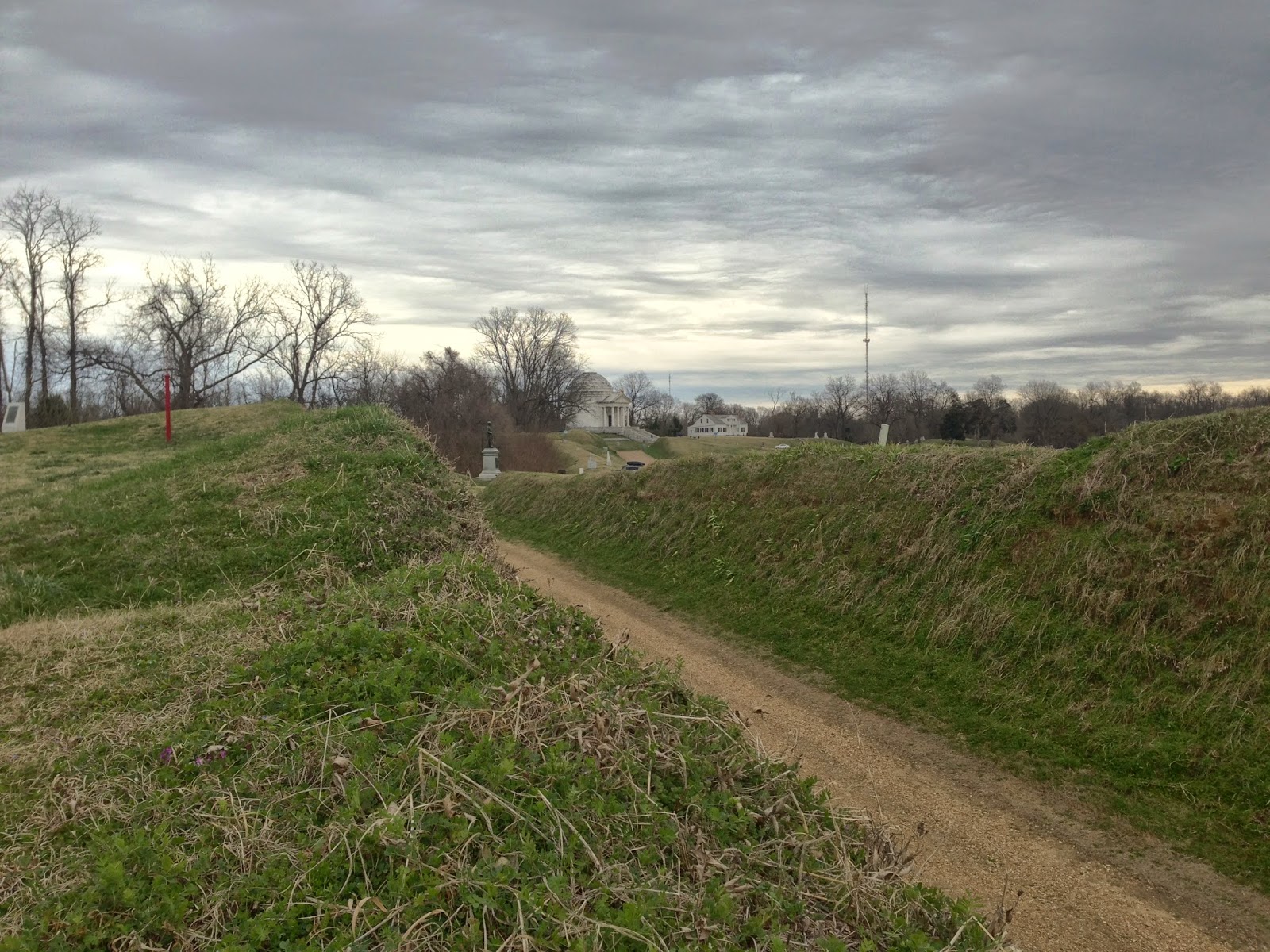
In an eerie precedent to World War I, Grant’s troops build zigzag tunnels, slowly crawling to the fortress. At maximum, the tunnels creep to within ten feet of the fortress, primed to undermine the walls.

The Confederates hope against hope for another army (Johnston’s) to relieve and resupply them.  They pray for Johnston to surround Grant and lift his siege. In the Confederate dream world, Johnston would attack Grant from the rear while Pemberton charged from the front, turning the Union siege into deadly Confederate pincers.  Unfortunately for the South, Grant previously chased Johnston’s Army out of Jackson, Mississippi, dispersing Johnston’s men across the South. Johnston eventually regroups, but far past too late.

On July 4, 1863, forty-seven days after the siege began, Pemberton assesses his situation.  Viewing his exhausted food and medicine supplies, Pemberton surrenders. Vicksburg is the battle that ends the Confederacy, not Gettysburg.  The loss of Vicksburg opens the Mississippi to Northern shipping as Pemberton surrenders his army of 29,500 men, 60,000 small arms, 200 canon and tons of ammunition, all irreplaceable by the agricultural South.

120,000 people fought here, each side losing 10,000 troops.  Following Pemberton’s surrender, Grant takes the Confederate soldiers’ weapons and sends them home, most heading to states west of the Mississippi.

Leaving the Visitor Center, we return to Pearl, waking her up to begin touring the battlefield.  We begin with the Union side.  The tour takes us through many stops, showing us the back-and-forth of the siege.  The boys find this far more interesting than I do, but I am patient and have reading material. Our tour continues on the Confederate side, the boys jumping out of Pearl at every designated stop.


 As we drive about, we find ourselves following an ROTC group of college students.  We ask which college they attend. They reply in strongly accented black rural speech, “Northwestern” with some unintelligible word appended to it.  “Northwestern in Chicago?” we think, puzzled.  Listening more closely, we hear Northwestern State University (NSU), a college indeed located in Louisiana, near Shreveport.

At each stop, a different NSU student gives a report, augmented by their ROTC sergeant.  The sergeant speaks of the importance of “unity of command”, meaning that a command issued top side would be obeyed down to the very last private. We take this as inherently obvious now.  But 150 years ago… Strongly eschewing advice, relishing slavery, independence and states’ rights, the Confederate side sorely lacked unity of command.  We learn that Jefferson Davis, not on site, issued battle commands from his porch, only to find his incompetent orders routinely ignored. The ROTC sergeant speaks of lieutenants ignoring generals, and everyone doing their own thing.  Lincoln had the sense to stay out of Grant’s way.

The clouds portentously grow darker, building as we observe a battlefield littered with monuments to each group of people who fought. The Illinois monument has a long formal staircase leading up to a large rotunda (in reality a scaled-down Pantheon) with an eagle standing guard over the monument’s entrance.


The two states where brother fought brother (Missouri and Kentucky) have the most poignant monuments. Located where two Missouri regiments clashed in battle, Missouri’s monument, dedicated to both Union and Confederate soldiers, features a huge monolith fronted by an art deco angel (the Spirit of the Republic), who dares anyone to refute the courage of the combatants.


Situated between the Union and Confederate lines, Kentucky’s memorial contains life-size bronze statues of Lincoln and Davis, both Kentucky natives. Behind the two men we find quotes from each supporting the Union.


Both Barkley and Bear, Pennsylvania natives, solemnly pose for photos at their state monument. The Union side has many monuments to Ohio regiments, but no Ohio Monument overall. As a person born in Ohio, I feel we disrespect our fighters, probably for budgetary reasons.  I am embarrassed.


The clouds, having gathered sufficient strength, begin dropping rain.  Fortuitously we finish touring the outdoor battlefield. Pearl motors up to the USS Cairo museum (pronounced like Karo, the corn syrup).

By January 1862, the Union, flexing its industrial muscle, constructs seven ironclad ships for the war effort, naming each ship for a northern city, including one for Cairo, Illinois.    Later that year, the Cairo, while working on clearing the Yazoo River of mines, hit two of the “infernal machines” and sank in the resultant explosion, becoming the first ship ever sunk by electric torpedoes.  One hundred years later, people raised the sunken ship, giving it to the National Park Service as a museum piece.

The ship itself indeed rests outside, covered by a large tent-type structure that resembles the multi-peaked tent roof at DIA (Denver airport).  Remaining dry, we explore the ship, impressed by the technology.  I often think of the Civil War being so far removed from today.  But even 150 years ago, we built a steam-powered, armored watercraft bristling with cannons.  The boys closely examine the boilers and engines as we wander about the craft. 


We walk into the indoor museum adjacent to the ship.  The Cairo sank quickly and lay undisturbed for 100 years, creating a time capsule.  From various displays, we learn about life aboard the ship.  We see lanterns, cooking equipment and “irons”—hand and leg cuffs used on recalcitrant crew members.  Medical equipment includes scary surgical items as well as myriad bottles of medications. Hastily abandoning ship, people left behind their personal goods.  The museum houses the forsaken shoes, shaving gear, and most movingly, photos of loved ones.

As much as I enjoy exploring daily lives of people born long before me, by late afternoon hunger ambushes me.  Hoping for some sustenance, I enter the museum restaurant.  Disgusted by the smells of horrendous Sysco-truck quasi-food substances, I begin to melt down.  The boys, alarmed by my predicament, appease me by cooking real food in the parking lot in the rain.  I am fortunate to have such caring animals in my life.

Finished with the Cairo and Vicksburg National Military Park, we return to our hotel.  I find my feet swelling and begin legs-up-the-wall exercises.  Exhausted, I fall into a dreamless sleep.  Tomorrow, we explore a wee bit more of Mississippi.


Tuesday, March 31, 2015

Thursday, February 27, 2014 – Southern Pride & Northern Prejudice

We face even colder weather this morning.  Brrr!  Although certain that the mercury has fallen to 20°, I must admit that Pearl’s thermometer reads in the mid-40s. Today’s wan sunshine probably brings a dearly desired coolness to the area in summer, unwelcome now during the waning days of winter.

Bear, ever the morning commandant, rounds us up and chases us out of the door by 9 AM.  We leave our Airbnb nest reluctantly, worried about a week of inhabiting kitchen-less hotels and the bad restaurant food we will be forced to consume in desperation. But the boys soldier on, stuffing Pearl and her hat with our worldly belongings. We haven’t quite succumbed to refugee status.  Katrina descended upon the Gulf in 2005, not 2014.  But as we approach a month on the road, have we not become gypsies?

Bright-eyed and bushy-tailed, Bear, our wonderful morning chauffeur, steers Pearl up toward Baton Rouge once again.  Passing Baton Rouge, we turn north on state route sixty-one, heading for the scariest place in the United States:  Mississippi. Where were the civil rights workers slain? Mississippi. Where was teenaged Emmett Till tortured and murdered? Mississippi. Where was Medgar Evans assassinated? Mississippi. What’s the locale for every scary movie about the Klan? Mississippi. Does driving a new car in the land of conservatives scream liberal? This place scares the bejeebers out of me.

Ten miles inside the state, my fears spring to life.  The Mississippi Highway Patrol, a police force whose cruelty knows no bounds (per the 1960s and Hollywood), stops all motorists. Pearl trembles as my heart rises to my throat, beating so loudly as to be heard a mile away. Ominously, to the right, on the road’s shoulder, we see a white boy cuffed standing behind his car. “Oh my gosh,” I think, shaking in panic, “we have Colorado plates. These boys will have a good old time looking for marijuana, ripping Pearl, her hat, and Sven asunder.”  Our inanimate partners quiver with barely suppressed terror.  We picture ourselves on the side of the road in Mississippi, our belongings strewn everywhere.  Sven, conflated with Pearl’s transmission, both in a million pieces, blow about in the wind.  We cry helplessly seeing our lives scattered all over the roadway, while the police laugh heartlessly.

The patrolman approaches.  “Good morning, sir,” he drawls, “license and registration please.” Keith hands over the requested documents quickly, the only sign of nervousness he displays.  The officer scans Keith’s driver’s license and examines Pearl’s registration.  Looking at the front license plate, he begins to guffaw. “Colorado, eh? Ha Ha Ha.  Cold out there, huh?  Enjoy your travels in Mississippi. Have a good day.”

Keith explains that “stop ‘em all” provides much needed money to rural police departments, now a standard revenue source in the South.  Ask every driver passing by to produce a valid driver’s license and registration while searching for unpaid traffic tickets and outstanding warrants, and no one can complain about discrimination.  People failing the checks face jail, requiring them to shell out more moolah to escape authority’s clutches.  Living in poverty, people allocating scarce economic resources between electric bills and traffic tickets will often leave the latter unpaid.   The rich, who would squawk and quash the practice, will sail through these tests; the Republicans will be glad to see the boys working at keeping the riff-raff in line.

A mere forty-five minutes later, my adrenaline level finally subsides as Pearl drives into Melrose Plantation of Natchez National Park. We find, wonder of wonders, a picnic table!  Exiting Pearl, we sit amidst blooming chickweed, enjoying the sunny, open space.  The boys heat our lovely lunch, prepared last night by the ever industrious Keith. We enjoy our chicken, zucchini and pasta. Unfortunately we couldn’t convince Bear to prepare meals for an entire week, no matter how much assistance we proffered.  “We don’t have a refrigerator Beaver, much less a freezer. You’re being ridiculous, worrying far too much about the Sysco truck.”  “But we have a cooler and ice,” I feebly responded.  And I hadn’t said a word about that darn truck!

In 1990, the National Park Service (NPS) acquired Melrose Plantation, including the Greek Revival mansion and surrounding buildings that once created the plantation’s wealth.  The NPS has busily restored the property.  Sven and I motor about on paved trails.  We see slave cabins and various outbuildings, entering the accessible ones.  Displays teach us more about slavery. 


We learn that the overseer, not the aristocratic planter families, determined a slave’s quality of life.  The planter would contract with the overseer for a projected profit. If the overseer failed to produce adequately, the agreement generally permitted the planter to dock the overseer’s pay.

Cotton plantations ran on debt, generally 70% of their value.  Planters borrowed heavily to buy slaves, land and seed.  A slave cost $500 and was expected to generate $100 to $200 each year.  With patience and luck, a plantation would eventually turn a profit. 

Success or failure depended upon the slaves’ survival and continued ability to work. People, both planter and slaves, would die in cholera and yellow fever epidemics.  Every plantation had a slave infirmary, where the mistress of the house’s duties included nursing people back to health.

The South welcomed many planters who had exhausted their Virginia land growing tobacco.  Selling their depleted northern land, they would move farther south to new land.  Borrowing heavily, they established cotton plantations, bound by both their new and old obligations.

For the enslaved, tobacco farming required the least amount of labor, cotton more, and sugar the most.  Sugar plantations subjected exhausted people to horrendously dangerous processes, often proving lethal. Succumbing to accidents and overwork, people on sugar plantations seldom saw forty.

Leaving the Melrose Plantation, Pearl cruises a few miles west to deliver us to the Longwood Octagonal house.  Jumping out of the car, we sign up for the tour. 
Sven comments, “Like we ever jump, Beaver.”
“Poetic license, Sven, poetic license.”
“Who gave you a license, Beaver?  You don’t even drive anymore.”
“Why the State of Colorado did!”
“Poetic license or a driver’s license?”
“Ok, you win, now hush.”
Sven subsides as the tour begins, focusing all attention on our guide.

In the 1850s, a planter named Haller Nutt developed an important strain of cotton.  Flush and arrogant, Nutt began contemplating Longwood in the late 1850s.  He planned a 33,000-square-foot, six-story octagonal masterpiece, larger than Thomas Jefferson’s mammoth plantation at Monticello.  Designed by northern architects, the house eschewed the currently fashionable Greek Revival style so often adopted elsewhere.  Nutt’s architects incorporated the then-current ideas of health into Longwood, specifying windows and a coal fireplace for every room.  Work began in 1860 but the outbreak of the Civil War quickly interrupted construction, as Nutt’s craftsmen fled north.  Hiring local workers, Nutt only managed to complete the 10,000 square-foot basement before dying of pneumonia in 1864, leaving his house unfinished and his affairs a mess.  His neighbors long ago renamed the uncompleted mansion Nutt’s Folly.


The Civil War brought economic collapse in its wake.  Nutt lost nearly all his wealth as both armies ravaged his plantations.  Julia, his widow, sold off land to satisfy debt and moved into the basement with her eight children, raising them there.

Being from Colorado, we are the seven-day wonder here.  Our guide, a large, fiftyish, balding, potbellied man notices our Colorado license plates. “Well,” he says “I sure wish that Mississippi would legalize pot. But we will be the last state to do so. Marijuana is a lot better for you than alcohol. What would somebody smoking pot do? Rob a grocery store for a Twinkie? I’ve smoked it before, and I would smoke some now, if I had it.”

Taken aback, we respond, “Well, we don’t have any marijuana with us.  But people and money are pouring into Colorado.  We want the taxes to fund our schools. We’re embarrassed to admit that we’re fortieth or so in spending on education.”

“I’m sure Mississippi is worse,” the big man opines.  (Correct: Mississippi consistently ranks 48th.)  “Years ago, when the government told us we had to integrate, the people in power chose to send all the white kids to private schools and not spend a cent on public schools. That’s what generated the mess we’re in now. Maybe marijuana would be a way out,” he muses.

Leaving our guide to his fancies, Pearl drives off to nearby small-town Southern America: Natchez, MS. Though comprising only a few city blocks of handsome old brick buildings, Natchez has its own National Park downtown: the William Johnson house.


Johnson, a freed slave (presumably his white father manumitted him), founded the town’s barber shop. Over the years, guided by sound investments and his own good business sense, he became quite rich. As owning other human beings marked one as a person of importance, Johnson eventually bought several slaves; once, he even sold a frequent runaway down the river, an action that he records in his diary as keeping him from sleep one night.

Although rich, Johnson died at forty-two when he was gunned down in a property dispute. His assailant, another free black, claimed some 1/16th white ancestry and got off scot-free – black people couldn’t testify against white people in criminal cases. (Later research showed the assailant to be part American Indian, not white, but the court ruled that evidence inadmissible.) William Johnson had straddled both worlds of the racial divide, rising to wealth in the antebellum South, but in the end his skin color still determined his fate.

Departing, we at long last reach the Natchez Trace, today’s goal.  Evolving from an ancient Indian highway, the Trace spans 440 miles from Natchez, Mississippi to Nashville, Tennessee.  In the early 1800s, people in the Ohio river valley would load all sorts of trade items (cash crops, animals, anything they could sell) on a flatboat and float down the Mississippi. Reaching New Orleans, the self-made merchants would sell all, including their raft for lumber. Goods-free and cash rich, they would then walk back up the Natchez Trace to their homes.  The boys ruminate about the manhood-building potential induced by hiking the entire Natchez Trace, deciding right there upon a future vacation adventure.  Sven rolls his eyes.

The federal government began building the Natchez Trace Parkway in 1936.  Finally completed in 2005, the Trace greatly reminds us of the Blue Ridge Parkway. Did the Park Service employ the same engineers or just repeat success?  Ten miles into the Trace, Bloodroot stops Pearl near a huge earthen mound named the Emerald Mound.   Constructed by Mississippian Indians in 1200 CE, the second largest mound in the Americas (after Cahokia) looms over us, dwarfing us.  We climb to the top of the mound to watch the sunset.  Descending, we notice that the darkness has also descended.  Pearl insists upon leaving the park. “There’s nothing but bends and shadows, kids,” says Pearl.  “I vote for safety and expediency.” 


 Exiting the park, Pearl returns to Highway 61 for our last amazingly painful half hour’s drive of the day.  Ultimately arriving in Vicksburg, we find ourselves weary, sore and hungry. First stop, Fairfield Inn, where we reserved an accessible room.  At the front desk, we learn that we’ve arrived too late for a handicapped room. “We’ve rented them all.  It’s a good night,” says the desk clerk.  “Yeah, good for you, not me,” I think. 

Resigned to failure, we check into our room and I head to the bathroom. Ugh!  The room lacks bars around the toilet. Can’t we just put bars around all toilets? We’re all getting old!  From Sven, I must standup without support, turn around and sit on the pot. Scary!  We decide to use Tinky instead. I can spin him around, only banging in the walls a wee bit, and sit. Tinky also helps me stand when the time comes.

Enough about toilets and cripples already!

While I flounder in the bathroom, Bloodroot and Barkley busy themselves finding a restaurant. Consulting Urban Spoon and Yelp, the boys recommend a place called Roca’s.

Bloodroot drives, easily following directions downloaded onto his iPhone. (The more I age, the more I’m surrounded by technology I don’t understand, like iPhones.)  Venturing a bit out of town, up a winding road, we stumble upon what appears to be a country club.

We enter the restaurant and sit down for dinner amongst all the movers and shakers of Vicksburg, Mississippi.  The Springfield Grill in Youngstown, Ohio, comes to mind, home of the selfsame people and mediocre food.  Full of trepidation, I begin with a green tomato and crab cake appetizer, something I’ve never had before—and it’s good!  Appearances can be deceiving, yes?  The boys get an A+.

A table across the room erupts repeatedly into unrestrained cheering as some basketball team beats another. We think it might be Arkansas versus Kentucky.  Giving the server our dinner order, we struggle to be heard over the mayhem.  Concentrating on the appealing food, we attempt to ignore the increasingly enthusiastic shouting, the kind you’d recoil from in an outdoor football stadium. The table’s occupants appear to be somewhat trashed.

Fortunately, the game ends while we dine.  The loud people rise to leave. One of the gentlemen stops by our table to apologize for the noise — very Southern. He explains that he and his friends, all lawyers, went to the University of Arkansas, which has just very handily beaten Kentucky. Asked which team we support, we mumble that we’re from Colorado.

“Colorado!” The man exclaims. “I’ve been skiing in Colorado.” He then launches into a very long story telling us each and every slope he has skied down.  He begins demonstrating his schuss skiing techniques by jumping about at our table. We sit spellbound, watching this very drunken man regale us with skiing stories while flapping both his arms and legs all over the place.

“Once going downhill, at Vail, I crashed into a rock, losing my goggles, skis and helmet. I looked up to see people on the lift worried about me. I waved to show them I was alive…”  At this moment, his friends walk by and collect him.  Our storyteller’s friends presumably usher him to a waiting car, so we never get to hear the end of the story. How did he get off the rock?  I’m totally sucked into the magic of the captivating tale, told the way only a Southern boy can tell it, and poof, he’s gone. Shoot!  An eternal mystery!

We finish our dinner, enjoying a sumptuous dessert, and head back to the Fairfield Inn for the night.  The boys dream of the Civil War, planning tomorrow’s exploration of the Vicksburg battlefield while they sleep.


Wednesday, February 18, 2015

Wednesday, February 26, 2014 – Baton Rouge

Keith enforces an early start today. Forbidden to dawdle over our breakfast of grapefruit from the Laura Plantation, we head out to Pearl.  We find the weather cold, 52°.  Shivering, Keith retrieves our winter coats from Pearl’s hat. We had fantasized about not needing our winter gear again before returning to Colorado. Complaining and moaning, we enter our chariot. How did we become so wussy so fast? 

Heading for Baton Rouge, we continue the Huey Long audiobook, listening to his political melodramas.  We learn that Long’s impeachment arose from his attempts to tax Standard Oil. (Not that he was innocent of the impeachment accusations—he replaced corrupt government people with his own set of different corrupt people, loyal to him, of course.)

We drive up I-10 from New Orleans to Baton Rouge, keeping the Mississippi on our left and Lake Pontchartrain to our right.  Lake Pontchartrain, 600 square miles of water, scares us, shimmering portentously as we drive beside it. What if the dikes fail?  The lake, perched ominously above the city, overshadows New Orleans, the proverbial sitting duck.

After cruising for half an hour, with a sigh of relief, Pearl leaves Lake Pontchartrain behind.  Collectively we ponder.  Does Louisiana intend to write off New Orleans and the incredibly drunken violent people and the desperately poor homeless populating it?  (New Orleans’ murder rate remains legendary, close to the rates in drug-torn South America.)  But really, a sinister master plan? That sounds like way too much effort, but think:  just move up the river as needed, making Baton Rouge the new industrial New Orleans. Let the ocean drown all of the Crescent City’s problems. 

Approaching Baton Rouge, we again smell petrochemicals.  Looking out Pearl’s windows, we see tankers, barges and container ships lining the river.

After only a bit of misdirection, Pearl delivers us to the Louisiana Rural Life Museum. The museum’s only visitors, we meander slowly, enjoying having the place to ourselves.  The museum elucidates how the other half, the common people, lived.  We visit some of the 32 buildings spread over 25 acres. We see tiny slave cabins, a sugar house, various dilapidated outbuildings and a well. A reconstructed church prompts Barkley to commandeer the pulpit and begin preaching. Perhaps half of the outbuildings have placards explaining their purpose.  After a bit, somewhat confused, we enter the main buildings, deciding to devote most of our time to wandering through the massive barn and visitor center. 

Barkley preaching

Random buildings
I have never seen so much stuff accumulated in one location. Is the entire government of Louisiana secretly run by massive packrats? This place makes my hoarder aunt’s house look positively sparsely furnished, goat paths and all.  We first discover numerous antique wheelchairs.  Sven puffs with pardonable pride, as none of the old chairs looks the slightest bit comfortable and all lack batteries for self-propulsion.  “You’re lucky you have me, Beaver!” Sven proclaims.  Carriages share pride of place with the wheelchairs.  Amongst the clutter we find an old horse-drawn hearse. The hearse has curtained windows.  The windows confuse me. I understand taboos about viewing the dead, so why the windows? And curtains?  Do the curtains prevent mourners seeing the dead rise, vampire-like, and look out at them? Better mind your Ps and Qs!

Venturing on, we discover sugar mill equipment, as well as other areas stuffed with sewing machines, dairying paraphernalia, or cooking gear.  One area holds stacks of quilts complete with the frames needed to create them.  Another boasts a working demo of old tractors. In the farming room we notice a boll weevil catcher, definitely the most entertaining and whimsical thing we encounter. 

The museum disappoints us with its sole half-empty space dedicated to slavery. The only bright spot is a prominently-displayed, first-edition signed copy of Solomon Northrup’s Twelve Years a Slave.

Moseying along, we encounter cotton seeping out of a displayed bail standing in a corner. We touch it, marveling at the incredible softness. Cotton brings us comfort.  Look at your clothes—even now we drape ourselves in it.  Imagine the wonder of cotton having lived your life dressed only in stiff, scratchy, ever-wrinkled linen.  Yet cotton fueled the vile plantation economy.  Today the plant’s cultivation consumes massive amounts of water and pesticides.  The plant generates amazing profits, fostering numerous sweatshops throughout the third world.  When we closely examine our universe, we discover that everything exists in a state of gray, both good and bad. Could just one thing be completely good for once? Like cotton?
 
Putting our four heads together, we decipher the purpose of about half of what we see.  This museum contains everything our grandparents attempted to carefully describe to us when we never understood what in the world they were talking about. I ruminate about my mother-in-law Bernadine and the knowledge that died with her and her generation. She would have told us each implement’s purpose, scoffing while laughing at our ignorance. Walking through the museum, I hear her laugh and miss her lots.

We visit the gift shop on our way out the door. Unfortunately, they don’t sell the unique and iconic boll weevil catchers.  We depart empty-handed.

Leaving the museum, Pearl cruises ten miles over to the state capitol building. The infamous Huey Long, governor of Louisiana in the late 20s and early 30s, strove to create a modern masterpiece to show the world that Louisiana, under his leadership, had finally escaped the dark ages. Rejecting the traditional dome and rotunda look, Long erected a thirty-four-story Art Deco masterwork, still the tallest state capitol building in the States.

We enter the building, a fantasy world of marble, murals and high gold-leaf ceilings.  Two bronze chandeliers, weighing two tons each, hang from the ceiling.  Flags from every country that held dominion over Louisiana line one side of the high walls. The opposite wall contains large multi-paned windows that don’t really admit a lot of light, but it is a rather dim day.


Finding the capitol surprisingly accessible for 1930, Sven and I investigate the building.  We roll over to the legislative chambers. A kindly guard shows us the site of Huey’s assassination, right outside of the chambers, near the Governor’s Office. Huey died from gunshot wounds; five bullet holes scar the capitol building walls. Over the years, a series of administrators has filled in every bullet hole, save one. The guard shows us the secret remaining bullet hole, hidden behind a column. Huey inaugurated the tradition of walking about surrounded by heavily armed, machine-gun toting bodyguards. Reflecting history’s delight in irony, many believe Long to have been shot by his own men as they defended him. 


We take a rickety elevator up to the twenty-seventh floor observation deck. Looking out, we see formal gardens, Baton Rouge, and the Mississippi with a lone barge floating by.  Flowing below us for once, holding only one ship, the river here resembles the Mississippi we’ve pictured in our heads for so long, as opposed to the massive commercial jumble we found down south. 


Descending, Sven leads as we motor out to the capitol building grounds.  We tour the garden graced with low circular hedges and a huge statue of Huey Long, of course. Long’s statue and his body face the capitol building, guarding Louisiana for all eternity. 


Long remains controversial to this day. He holds a sainted status amongst many of the common people. People aren’t fools, they know he was a sleaze ball, but Huey brought Louisiana schools, textbooks, and roads, things the prior planter-class rulers never had bothered to do. Others, including our Lafayette Airbnb host, hate Long with a passion for both his arrogance and his venality.

Driving back to Baton Rouge, we complete our Huey Long CD, his assassination on the audiobook paralleling perfectly with today’s tour of the statehouse. 

We arrive home ready to launch into dinner, only to discover, horror of horrors, we have run out of both butter and olive oil.  Bear grumbles, “I don’t want to drive all the way over to Whole Foods. I’m sure I can find butter at the local grocery store.”  He walks out the door, list in hand, intent upon a wee bit of shopping in the ‘hood.  He returns shortly. “The local bodega is full of horrid petroleum-based quasi-food!  They don’t even sell butter!” he roars, brandishing his list and a small bottle of what he believes may be olive oil.  “And!” he shouts, stomping his feet and working himself into a full-fledged Bear rant, “some kid tried to sell me edible marijuana claiming that it was legal in New Orleans the same as Colorado!” Discretion being the better part of valor, I remain silent, but begin to think.  Hmmm, I recall, we learned on our Laura Plantation tour that Creoles only obey the laws they agree with. So perhaps edible marijuana is legal in New Orleans, at least in people’s minds. I wonder if Cole Porter composed Anything Goes after staying in this city.  (Nope—Paris)

“Ah!”  Bloodroot exclaims, ignoring the pot question, “we’re in a food desert.” Ensconced in my middle-class world, I must embarrassingly admit that previously I actually doubted the existence of food deserts, considering the noise a marketing ploy.  Darn!  Reality once again cruelly quashes my eternal optimistic belief in American equality and opportunity.

Following the abortive shopping trip, Keith starts dinner, creating yet another culinary wonder work. We eat slowly, enjoying every morsel, every sip of wine.  Is this our last supper? Do we fear an impending execution?  We’ve enjoyed six nights of healthy, delicious food, but tomorrow we leave our Airbnb nest for five nights in hotels. Ugh! I solemnly promise to attempt not to complain overmuch.  I swear off ranting about the Sysco truck, the truck delivering heavily-salted, corn-syrup laden foodstuffs to all restaurants, responsible for creating that signature restaurant flavor:  GROSS!  Ugh, an impending week of lousy food, heavy on salt and sugar.

Following our relaxing dinner, Barkley and Bloodroot decide to venture out into New Orleans. They desire to visit someone Bloodroot met in Paris. We charge them with discovering all the dirt on this person—where he works, sexual preference, who he’s dating, etc. The boys roll their eyes at me, disgusted by their assigned mission.

The boys consider themselves nerds, tending to carry their laptops with them.  Off they go, exploring this brave new world, post-Katrina New Orleans. They return a bit later, sans gossip, excitedly reporting that they had been approached and offered both drugs and sex! Charitably, I wonder if this actually represents a desperate nadir in the sex workers’ and drug pushers’ lives. Has working the Mardi Gras tourist trade become unprofitable? Are the other tourists just too trashed? Or does everyone come to New Orleans to act irresponsibly, even nerds?  Perhaps the entrepreneurs sense a golden opportunity here.


Grateful that boys resisted the dual temptations of both sex and drugs, we turn in for the night.

Thursday, February 5, 2015

Tuesday, February 25, 2014–Chalmette Battlefield–Yet Another Jean Lafitte National Park

Today, Pearl escorts us to the Chalmette battlefield, about five miles downriver, to the southeast of New Orleans.  Bear begins to worry about directions.  “Calm down, Bear,” Pearl says a bit huffily. Keith relinquishes control, giving Pearl the helm and placing our fate into her hands.  “I’m well aware that Louisiana has six Jean Lafitte National Parks. I’m also smart enough and quite capable of taking you to correct one.”  After a harrowing drive along the silty riverside road, she triumphantly delivers us to the Chalmette battlefield, the site of Andrew Jackson’s stunning victory over British forces on January 8, 1815.  “Hmmph! Told you so!” Pearl mutters, settling down to sleep while we visit the park.

Turning our eyes to the sky, we warily scan the damp gray clouds, harbingers of rather iffy weather.  Entering the National Park Visitor Center, we turn back the clock.  We travel to the last engagement of the war of 1812, (beginning December 1814.) The British Empire, the most powerful political force the world has yet seen, has defeated Napoleon just this past spring.  (The Napoleonic wars sputter on for another year, but the European Theatre no longer requires much British attention.)  Ironically, the wars push Great Britain to develop the most feared army in the world, while with her navy, Britannia rules the waves.

Before Napoleon’s defeat, many in the U.S. had thought declaring a new war on Britain an excellent idea—maybe we could swipe some of Canada while the French distracted the Brits! Many former war hawks, though, can’t shake a nervous feeling by 1814.  We’ve gained nothing in Canada, and with Napoleon’s defeat imminent, the Brits have now turned their attention to their upstart former colonies—miserable ingrates who dare to reject their rule and monarchy, then challenge them from behind Napoleon’s skirts. Dusting herself off from her European campaigns, Britain sends thousands of battle-tested troops to the US.

Intent upon re-conquering the rebels, the British plan a three-pronged campaign. The first leg, a full-scale invasion from MontrĂ©al, fizzles with the loss of the battle of Lake Champlain. In the second attack, the Brits manage to capture and burn Washington DC, but Fort McHenry in Baltimore stands firm, preventing the British navy from landing.  Finally, smarting from multiple defeats, the Empire turns its focus to New Orleans, a brilliant strategic move.  As most US commerce uses the Mississippi river, taking New Orleans will cripple the US economically and halt westward expansion, basically nullifying the Louisiana Purchase.

On December 23rd, British ships land 10,000 battle-hardened troops nine miles downriver from New Orleans. Gloating over his immense army and navy, the imperious, aristocratic General Parkenham writes glowing letters home, predicting a battle easily won and the American impudence quashed by Christmas.

Andrew Jackson stands between the British and America’s most valuable city. Jackson musters 5,000 troops, including his army regulars, French Louisianans, Cajuns, free blacks, creoles, Choctaw and Jean Lafitte’s Baratarian pirates. To motivate his impromptu polyglot militia, his motley band of misfits and the underprivileged, Jackson pardons the pirates of numerous federal crimes, pays everybody handsomely, and crafts a rallying cry guaranteed to appeal to every American, regardless of race or wealth: Wouldn’t we be better off under our own rule than subject to the whims of some distant European power?  In this hour, as the fate of the Republic trembles in the wind, the past is known; the future open. 

Jackson was a competent and forbidding general as well as a good leader. At our current location, he quickly built shoulder-high mud ramparts behind his makeshift moat, the Rodriguez Canal—ramparts thick enough to absorb cannon balls and enemy fire.  He positioned his people sparingly, safely and carefully where they could do the most damage.  Then he sat down to wait. 

The Brits soon arrived. Hemmed in between a cypress swamp to the north and the Mississippi to the south, Jackson funneled the Brits toward the Rodriquez Canal.  Under General Parkenham, the Brits charged the well-fortified U.S. earthworks in waves. Firing cannons from behind the canal, the Americans tore the British troops to shreds.  The battle ended in thirty minutes, with 2,000 British dead (including Parkenham), wounded or taken prisoner and fewer than twenty US casualties.  The British fleet sailed away at the end of the month, losing many more troops to festering wounds and disease on the way home.

Of course, Jackson’s vague promises to the American Indians and African Americans would prove false.  Unfortunately, the utopian multiracial government never materialized. Jackson, America’s conquering hero, failed as President, now remembered for his role in the genocidal Trail of Tears, as well as his decimation of the economy.  Until this tour, I had always considered Jackson our worst president.  Now I’m bestowing that honor on Bush II.

Why does every battle I know about (granted, that’s only a few) involve some highly-placed idiot attacking fortified artillery positions? Pickett obeying Lee at Gettysburg, Parkenham at New Orleans, and Bonnie Prince Charlie at Culloden—all attacked fortified lines.  Grapeshot, the original antipersonnel weapon, comprised of small lead balls packed tightly into a canvas bag then shot out of cannon, decimated their charging infantries with shrapnel.   It killed Parkenham and demolished Bonnie Prince Charlie’s Jacobites; Pickett’s men succumbed to canister shot, grapeshot’s successor.  Parkenham at least had the decency to die in the charge; the others survived after spilling the blood of so many of their followers.

The boys claim that Alexander the Great invariably used frontal assaults against a center line, sowing terror and overrunning enemy lines.  Alexander conquered before the invention of cannons and shrapnel. Has Alexander’s tactic been successful since the invention of modern weapons? The boys aren’t sure but agree that when a frontal assault fails, it fails spectacularly.

I wonder if this could have been our last just war against a foreign aggressor. And as guerrilla underdogs, we won. How odd that we’ve never learned the lessons of 1815 and continue to rely upon technology, arrogance, and very long supply lines to help us lose wars in Vietnam, Iraq and Afghanistan.  We don’t bother winning the locals’ hearts and minds; we’ve become the British.

We take Sven for a spin around the battlefield and check out the remains of the Rodriguez Canal, finding the mud ramparts have long ago returned to the earth.  Under today’s calm but cloudy skies, we find it difficult to picture the battle or its carnage. The mighty Mississippi lies just to the south of the battlefield.  We climb the levee to view the river; a fence prevents our summiting.  Looking out, we see huge tankers and container ships, each easily the length of several football fields, but we never find the river.  Perhaps the ships float along on an invisible jet stream.


After touring the battlefield, we return to the visitor center. At each park we visit, we ask the same question, “What will be the fate of New Orleans?” The personnel here opine, “We have ten years to put the wetlands back. After that it will be too late to save New Orleans.”  I query, “Is the problem caused by habitat destruction or climate change?” “Both problems contribute to our dilemma,” the ranger replies.  “Wetlands protect us from rising seas.  They absorb floodwaters, sparing the cities near the shore.” No one we’ve met has expressed optimism about continuing the status quo in Louisiana. Unfortunately, given the monetary and emotional cost of change and the lack of political will to undertake it, Louisiana seems poised to cling to yesterday until it’s far past too late.


Rain begins to fall as we climb back into Pearl.  We start our 10-hour CD, an audiobook about the life of Huey Long. Driving back into New Orleans under a warm Southern drizzle, we hear about Long’s impeachment, absolutely amazing political theater.  Politicians brawl in the Statehouse; one of Long’s brothers bites off an opponent’s ear.  Long finally dodges the bullet by rigging the House voting machines and then, while the House fixes them, buying off the Senate.